
A home where light delicately shapes surfaces, materials define volumes, and the tranquility of the rural landscape accompanies every space in a seamless balance between interior and exterior.
There are places that don’t ask to be shaped, but simply listened to. The countryside between the Itria Valley and the Apulian Murgia is one of these: a quiet horizon, punctuated by olive trees and the Adriatic Sea, sensed rather than seen, where architecture can only choose whether to assert itself or become one with the landscape. It is in this context that a House in the Ostuni Countryside takes shape, a renovation project by Tela Architettura, born from the desire to transform an unfinished building into a minimalist home with a sophisticated personality and designed to last.
The house in the Ostuni countryside emerges from the landscape as an essential volume, a trace of an architectural tale of proportion and harmony.

The starting point was not a home, but a broken promise: a reinforced concrete volume, abandoned, devoid of finishes and a true soul. The decision was radical in its simplicity: not to erase or start from scratch, but to proceed by eliminating the superfluous, without adding anything else, accepting that structure as the starting point..
The existing geometry thus became the skeleton of a new narrative, founded on proportion and elegant functionality. The approximately 150 square meter interior spaces were redesigned with surgical precision, while the extension was developed discreetly, without ever betraying the site’s balance.
The house opens onto the Apulian landscape: olive trees and hills intertwine with the horizon, integrating nature with the living spaces in a conceptual dialogue.

The relationship with the land was the true project. The openings were enlarged to let in light and the landscape, seamlessly integrating the exterior with the interior spaces. With this inspiration, the surfaces were treated with a coherent and uninterrupted language: natural lime plaster and sand-colored microcement cover the walls, floors, and volumes, creating a single, fluid material.
The pool steps are transformed into places for relaxation and socializing, becoming functional elements that emerge from the same material as the building.

From this continuity, slightly staggered levels emerge that take on different functions: steps that become seats, low walls that transform into furnishings, elements that are not added to each other but arise from the same matrix. Examples include the staircase to the pool, now also transformed into a resting place, the fireplace that emerges from the living room as a prominent presence, and the bed in the master bedroom that seems to rise from the floor, becoming an integral part of the space.
The bed in the master bedroom seems to rise from the floor, becoming an integral part of the space and redefining the sleeping area with discreet elegance.

Read also →
The Architect’s House – Tailored Modernism
Light is the other invisible material of the project. The cooler northerly light envelops the rooms with uniformity, while the eastern exposure brings warmer hues in the early hours of the day. The iron frames mark the perimeter of the windows with a dark, precise line, connecting the interior with the sculptural trunks of the olive trees and the rural landscape.
From the living room, the interior spaces open onto the pool, creating a continuous visual path that combines domestic comfort and the geometry of the project.

The entrance is filtered by a walnut screen that guides the gaze toward the fireplace, a central element that defines the rhythm and organization of the space.

Inside, the wood introduces a more intimate dimension. Doors and paneling create a tactile rhythm, a dialogue between smooth and textured surfaces. The living room ideally unfolds around the fireplace, the heart of the home, from which lower levels branch out, guiding the movement and organizing the space. A walnut screen filters the entrance, letting light in and suggesting a separation that is more perceptual than physical.
Dark wood tones meet metallic details, creating a restrained and measured atmosphere, while natural fiber rugs break up the continuity of the microcement, defining the areas dedicated to conviviality.
The living and dining areas are structured around low surfaces and integrated furnishings, creating fluid spaces designed for conviviality and everyday comfort.
Dark wood tones meet metallic details, creating a restrained and measured atmosphere, while natural fiber rugs break up the continuity of the microcement, defining the areas dedicated to conviviality.
The living and dining areas are structured around low surfaces and integrated furnishings, creating fluid spaces designed for conviviality and everyday comfort.

In the dining area, white surfaces meet wooden furniture, creating tactile contrasts and a discreet rhythm between elegance and natural warmth.

This design poetics is also found in the sleeping area, which houses three bedrooms, all with private bathrooms. The openings are designed as carefully calibrated incisions in the envelope, framing the landscape without exposing too much: light, shade, and privacy coexist in balance.
On the eastern side of the home, a lightweight pergola and the presence of olive trees help shield the summer sun, creating shaded and ventilated spaces where time seems to unfold and relaxation takes the spotlight.
One of the bedrooms features a bathroom painted burgundy, a bold contrast that defines the space with personality and distinctive character.

The built-in bathtub blends harmoniously, transforming the bathroom into a place of daily ritual and tranquility.

Returning to the exterior, the building integrates with the natural contours of the land thanks to dry stone walls
made of local stone, which define overlapping terraces and harmonious steps, following the curves of the land. Mediterranean vegetation envelops the house with shades of green and gray, shaping the view and enriching the sensory experience of the place.
Dry-stone walls shape the surrounding terrain, while Mediterranean vegetation envelops the house, creating a harmonious and welcoming atmosphere.

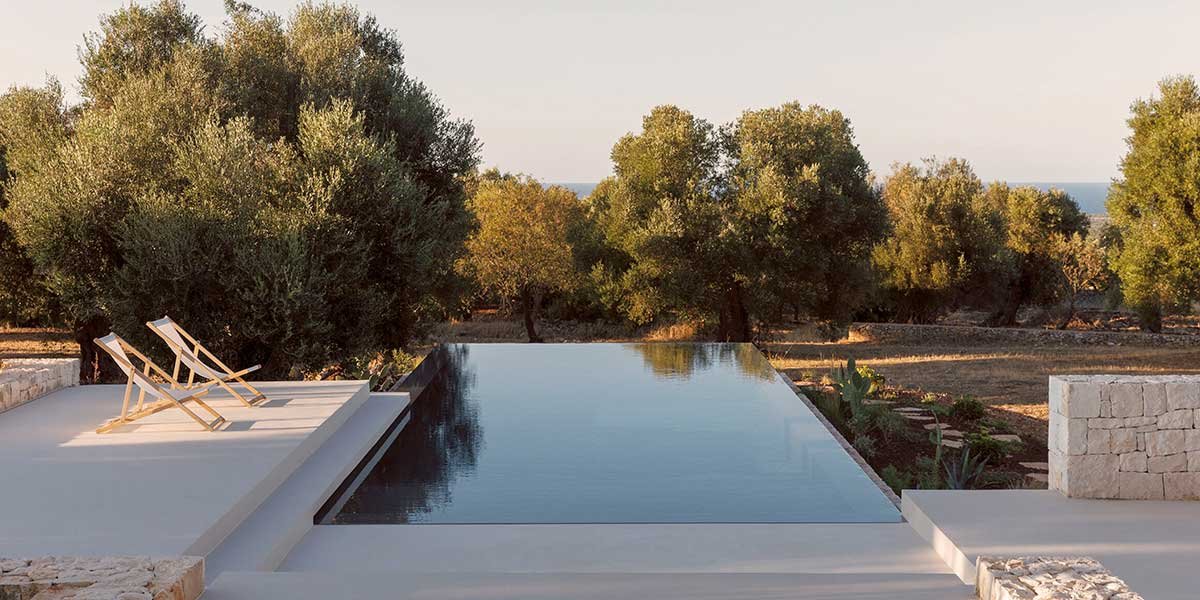
The infinity pool becomes a sculptural element, with its mirror of water that invites contemplation and relaxation.

At the edge of the property, an anthracite microcement infinity pool opens towards the horizon: the water, still and shining, reflects the surrounding sky and earth, transforming itself into a mirror that amplifies the feeling of calm. Every detail is designed to last over time, conveying a sense of balance and silent elegance.
Il risultato finale non è solo una casa ma un’esperienza di quiete e misura, un luogo in cui la luce modula gli spazi, la materia li definisce e la natura entra senza forzature, suggerendo gesti semplici e pause profonde, invitando chi la abita a rallentare, osservare e respirare il ritmo del paesaggio.
Project by Tela Architettura – telaarchitettura.com
Photo © Nicolò Panzeri
The floor plan of the house in the Ostuni countryside © Tela Architettura

In copertina, l’acqua della piscina si fonde con l’orizzonte, creando un incontro sospeso tra architettura e respiro della campagna.