

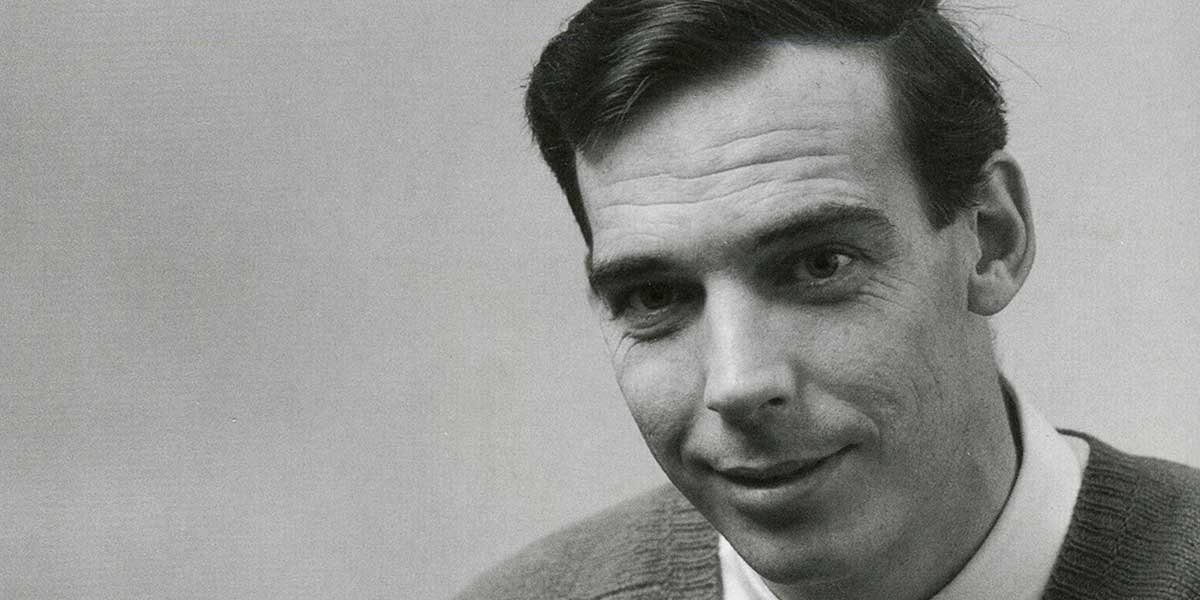
by Evi Mibelli.
“It is the intrinsic language of the materials that I want to express.”
Nordic design has always had a streak of inexplicable magic. And in the case of the Dane Poul Kjærholm it is unequivocally so. The source of inspiration is Nature. Even if lines, rigor, geometries belong to man, he captures the essentiality of nature. Nothing that comes from that world is illogical, efficiency is simply perfection, beauty, harmony.
Mies Van Der Rohe’s functionalist principle “Less is more”, or the even more frequently cited “Form follows function”, distances itself, in Kjærholm’s vision, despite being an admirer of the great master of the Modern Movement, from the cold rationality of the project and acquires an invisible link with the most spiritual and contemplative part of nature, a condition that every man needs to find peace. Poul Kjærholm succeeds masterfully in this endeavor. He is a romantic rationalist.
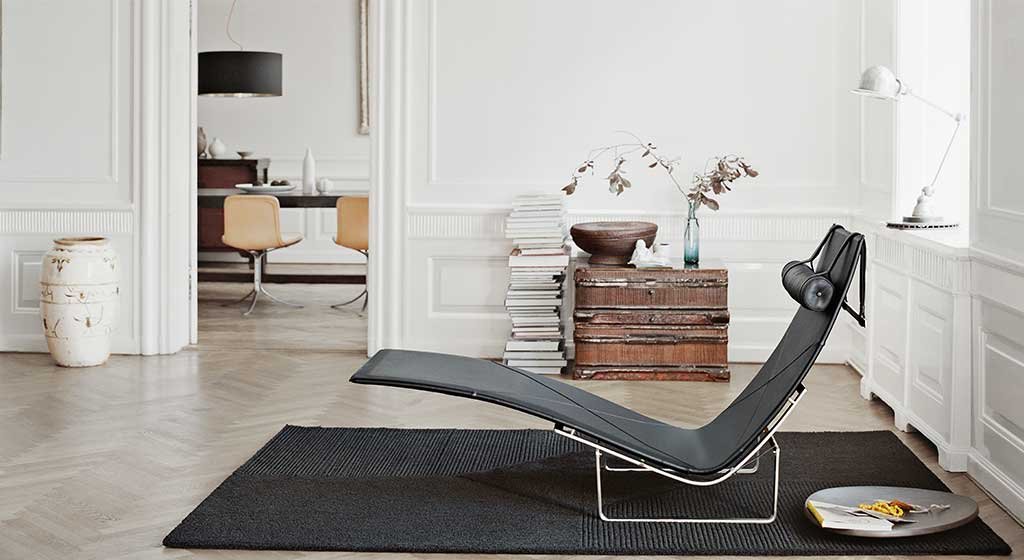
Lounge Chair PK24, 1965. Currently in production Fritz Hansen. Photo Fritz Hansen.
Born in Østervrå, Denmark, on January 8, 1929, Poul Kjærholm began his apprenticeship in a cabinetmaking workshop at the age of 14. Learn to know materials, understand their technical characteristics, intrinsic properties and how to work them masterfully. He enrolled at the Hjørring Technical School to learn geometry and technical drawing and at 18, having obtained a cabinetmaker’s certificate, he completed his studies in Copenhagen at the Danish School of Arts and Crafts, under the guidance of Hans J. Wegner.
A furniture architect, as he defined himself, he began to distinguish himself at a very young age with his designs characterised by the widespread use of steel, distancing himself aesthetically from most of his contemporaries, who were more tied to the Nordic tradition of wood and curved plywood. Demonstrating this predilection is his 1951 graduation project: an armchair whose frame is a single piece of bent harmonic steel and the seat is made from sturdy sailing rope.
“It was easy to work with a structure made from simple ready-made steel strips, and I was immediately fascinated by the many potentials of this new material.”
The result was a masterpiece – Element – (the current PK25) which earned him an immediate job at Fritz Hansen. He’s only 22 years old, has a bright future ahead of him, and is a cutting-edge company that recognizes his genius.
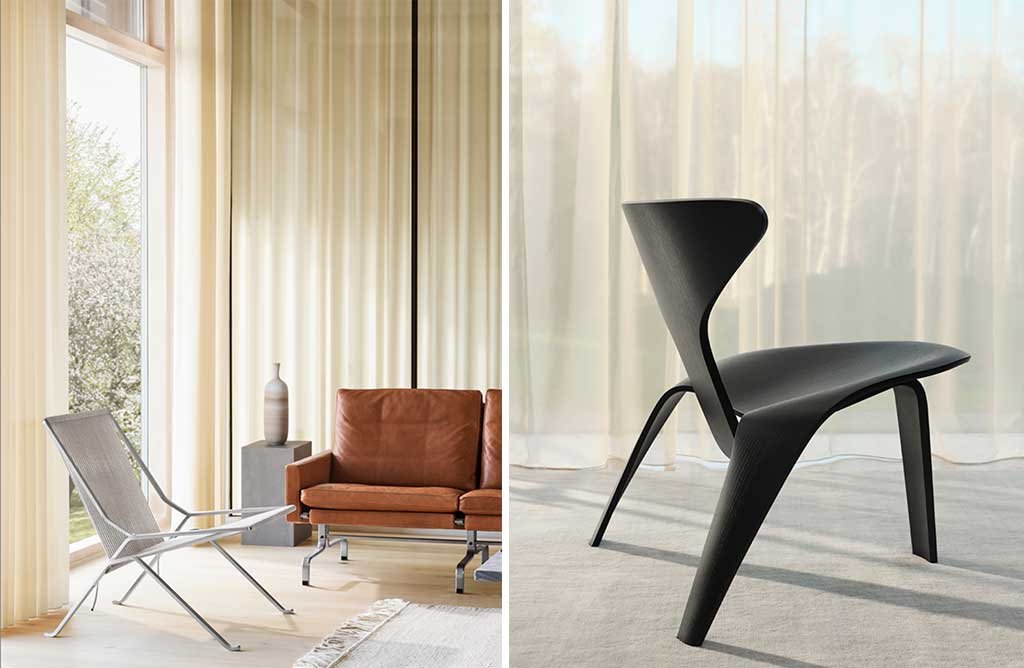
On the left, PK25 armchair, designed in 1951 for the graduation project. A masterpiece, in steel, of unparalleled precision and aesthetic purity. Photo from a Fritz Hansen catalog; right, PK0 A chair, designed in 1952 for Fritz Hansen. It went into production in 1997 in a limited edition. Due to its aesthetics and technical use of materials, it is one of the masterpieces of 20th century design. Photo from the Fritz Hansen catalogue.
Kjærholm spent the early 1950s searching for the material that would represent his vision of the project, pushing for simplification and, where possible, mass-produced products. Steel is chosen as the primary material of his creative production, without forgetting wood and other materials of the Nordic tradition, which remain elements of his original expressive language and also a legacy of his training as a craftsman cabinetmaker.
“The construction potential of steel isn’t the only thing that interests me. I love light, the refraction that strikes and brings its surface to life. It’s an interaction that gives substance to my aesthetic research”
Indeed, his knowledge and bold design approach give this material a dignity and elegance that extends beyond the design product itself, but influences the very aesthetics of everyday spaces. The interiors that welcome his furniture always convey a sense of space and warm welcome. Nothing seems out of place. It is true quiet, intimacy and light.
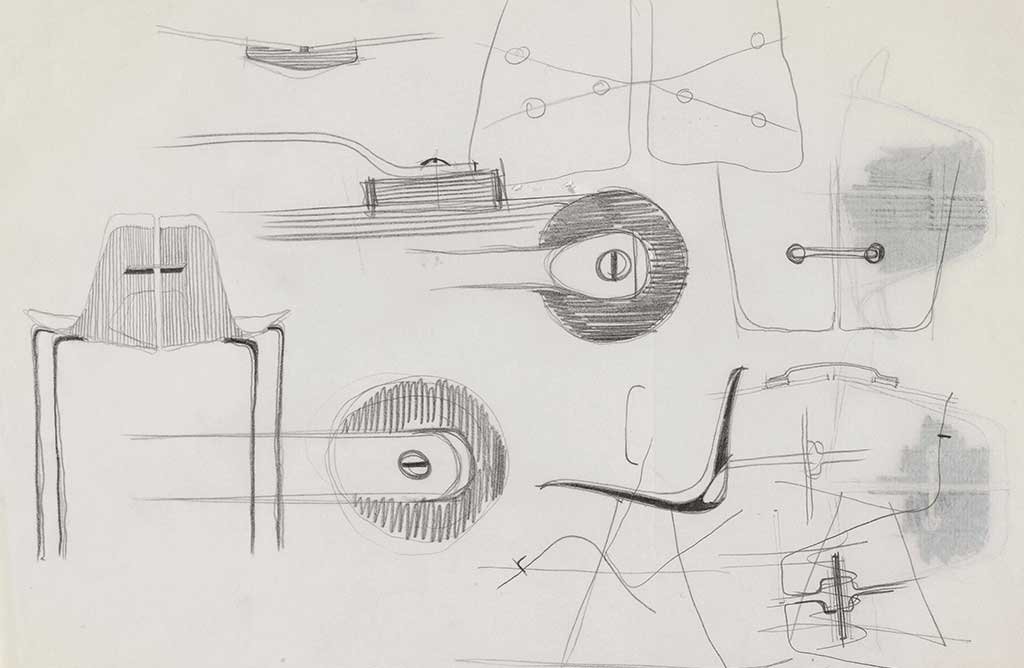
Original drawing of the PK3 chair by Poul Kjaerholm. Fritz Hansen Archive.
Sedia PK3 impilabile, in legno curvato e acciaio, in archivio dal 1954 e prodotta per la prima volta nel 2025 da Fritz Hansen. Photo from the Fritz Hansen catalogue.
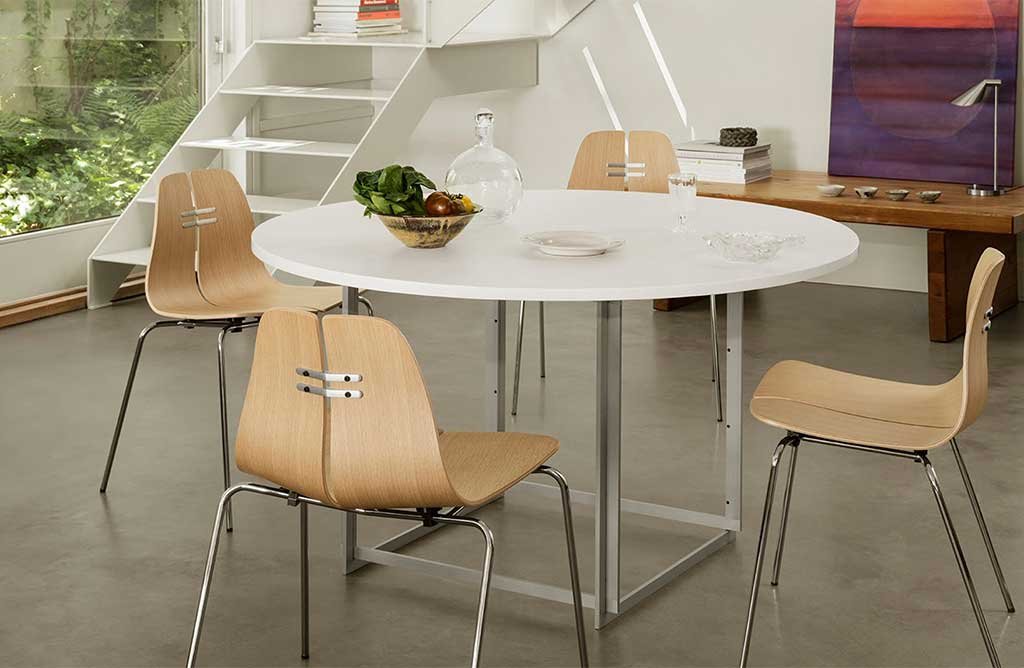
While working at Fritz Hansen, he designed an armchair made from two pieces of curved laminated wood, today known as the PK0. Un pezzo di design strepitoso per innovazione, ergonomia e bellezza, ma dal costo produttivo, per l’epoca, alto. Kjærholm wants to produce it at all costs, even before Arne Jacobsen’s Ant chair. He clashed with Fritz Hansen’s reticence, resulting in a rift.
He left the company and formed a thirty-year partnership with Ejvind Kold Christensen, a small furniture manufacturer and dealer in Hellerup. With him, he would produce many of his iconic pieces. His poetics established itself and marked a glorious era in design, winning international recognition and awards, including two Grand Prix at the Milan Triennale (1957 and 1960), the ID Award (1973), and the legendary Lunning Award (1958).
He taught at the School of Arts and Crafts in Copenhagen, and in the furniture and interior design department of the Academy of Art from 1957 to 1976. His designs are now in the permanent collections of the Museum of Modern Art in New York, the V&A Museum in London, and other museum collections in Denmark, Norway, Sweden, and Germany.
On the left, PK11 chair with natural leather seat, combined with the PK51 table. Photo from a Fritz Hansen catalogue; on the right, PK4 armchair in painted tubular steel and natural cord seat, 1952. Photo from the Fritz Hansen catalogue.

Bridging the gap between industrial design and craftsmanship, he has distilled basic furniture typologies to their essence, creating a unique body of work that reflects his ideas and values: the essential, nothing more; a love of nature, nothing less.
Seeing the natural world as a source of inspiration and as the ultimate standard of beauty, Kjærholm saw nature’s simple, efficient forms as a guiding model. His goal was to create furniture that appeared as timeless as the leaves of a tree or the windswept meadows of Jutland. In private, he was a great collector of photographs of landscapes, plants, and birds. Una passione che spiega molto della sua poetica.
PK20 armchair, a design classic by Poul Kjaerholm (design from 1968) present in the permanent collection of the Victoria & Albert Museum in London. Photo from the Fritz Hansen catalogue.
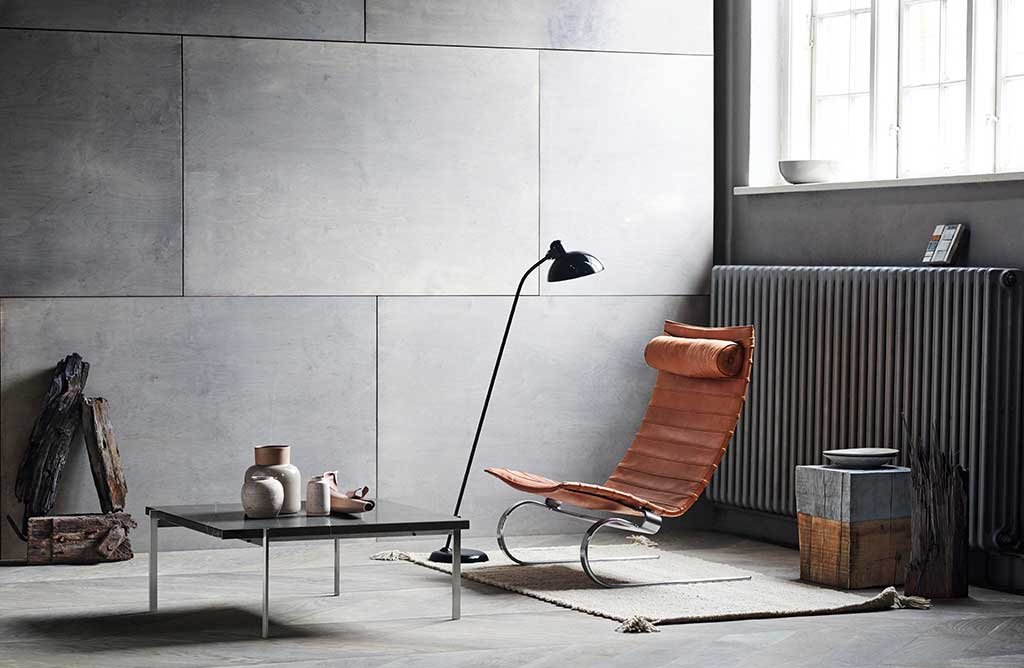
Returning to his design style, Kjærholm always brings out the intrinsic properties of materials. The steel elements are as thin as possible to highlight their strength, and the matte and chrome surfaces give the metal a degree of warmth and visual softness that pairs wonderfully with other materials. It enhances the naturalness of the colors by excluding the artificial use of color: leather, wood and stone are left as they are or finished in the simplest way possible to enhance their natural qualities.
The PK0A chair and the PK60 table create a formidable aesthetic synthesis of technique, form and function. Photo from the Fritz Hansen catalogue.
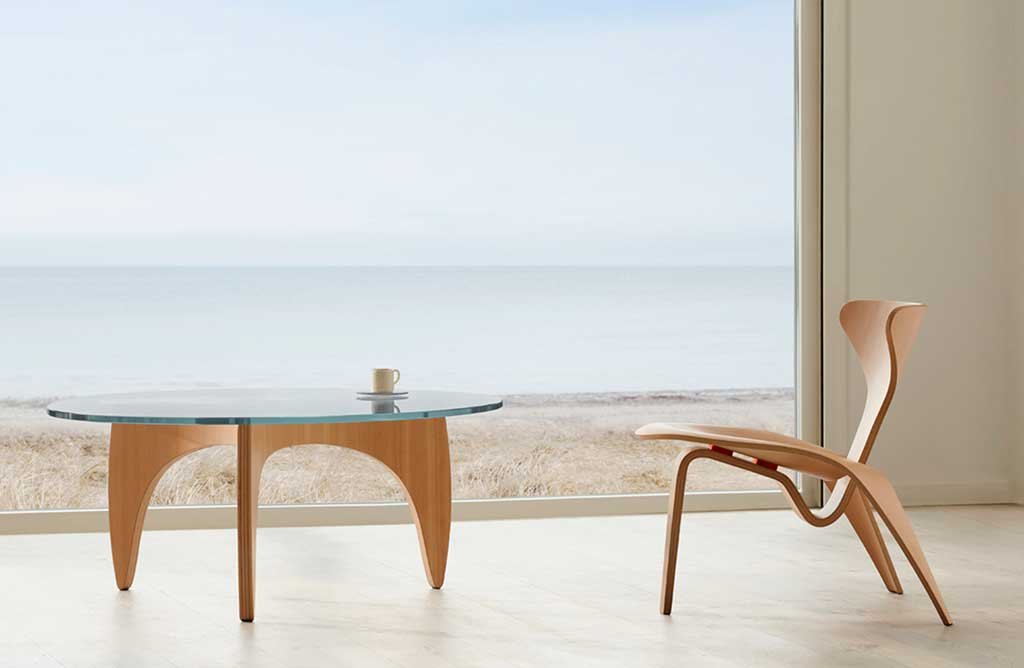
Poul Kjærholm’s uncompromising approach to design made his furniture expensive to produce, limiting the market and curbing his ambition for mass production. It is no coincidence that his pieces, today, are highly coveted objects in design auctions, sold for decidedly high prices.
After Kjærholm’s untimely death in 1980, Christensen was no longer willing to continue. In 1982, Poul Kjærholm’s executors entrusted Fritz Hansen with the production and sale of the Kjærholm Collection: over twenty projects developed between 1951 and 1967, including the successful seat, now in the catalog as PK25 – also in the black rope version – scrupulously created starting from archive drawings. Poul Kjærholm was known for never letting a project he didn’t think was perfect leave his studio door.
On the left, Daybed PK80, 1957, inspired by Mies Van der Rohe. PK62 low table, 1968, with white marble top and satin steel structure. Photo Fritz Hansen; right, portrait of Poul Kjærholm in his studio. Fritz Hansen Archive Photo.
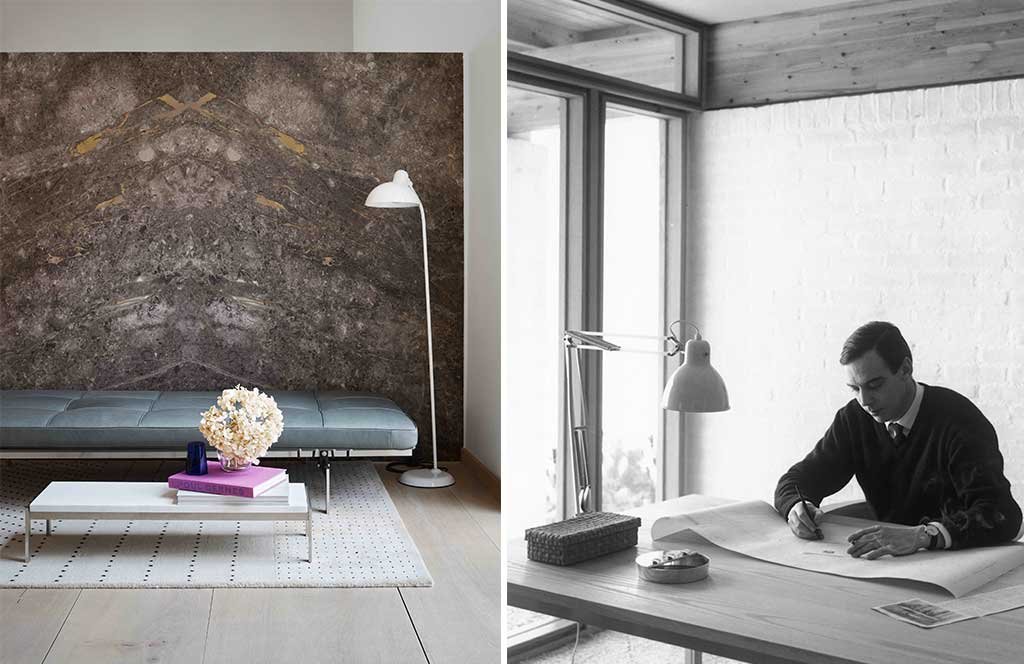
On the cover, Poul Kjærholm (Fritz Hansen Archive).