

by Evi Mibelli.
A Turin home where time becomes matter and every room tells a story. Vintage furnishings, flea market finds, objects rescued from oblivion, and bold colors blend together slowly, creating a personal and ever-evolving living space. An invitation to make slowness a new way of decorating.
In Turin, in a late 30s twentieth-century-style building, a nearly 78 square meter apartment has preserved its original features, following a minimal renovation. The magic of this home lies in the rare sensitivity of its owner—a goldsmith and fashion designer—who expertly combines colors, lights, fabrics, secondhand and vintage objects and furnishings, creating a balance of original contrasts and delicate harmonies that offer inspiration for a slower, more creative, personal, and even low-cost approach to home decor.
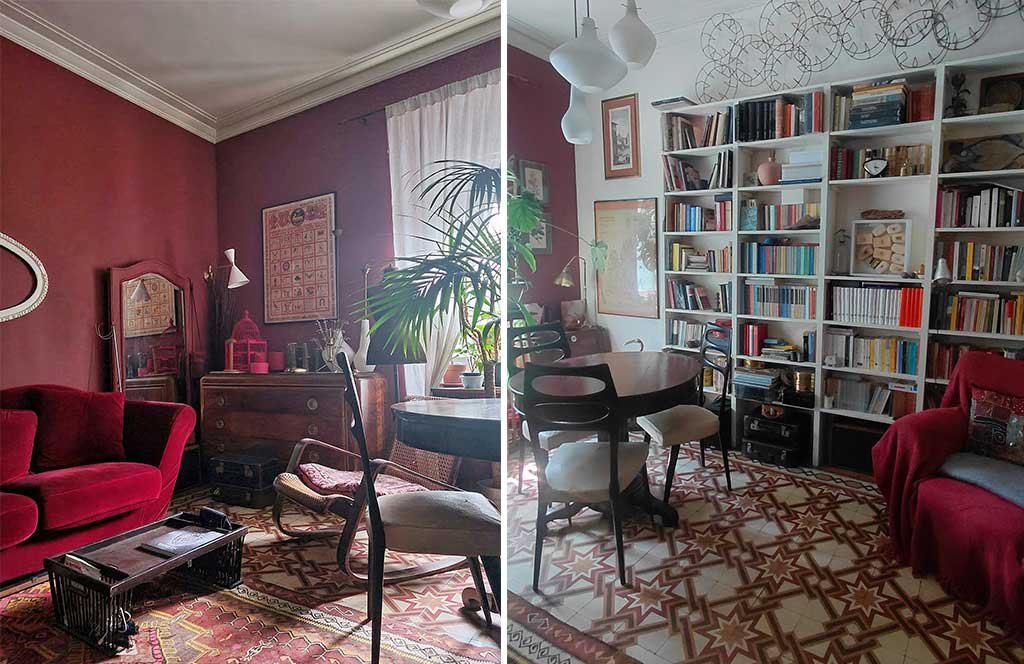
The period flooring provides the chromatic backdrop for transforming the living room into a space with a rich and multifaceted personality. Sections of the walls are glazed a dark, satin red, against which the strictly secondhand furnishings project, creating a bygone atmosphere. The chest of drawers is a typical example of Italian Art Deco, with a rounded shape and molded glass knobs; the rocking chair is an original from the 70s, designed by Luigi Crassevig; the wall light is a mid-century model inspired by Stilnovo, as is the three-piece chandelier in white opaline glass. The solid walnut table dates to the late 800th century, while the chairs date to the 50s and are attributed to Vittorio Dassi. On the opposite wall is a large custom-made bookcase.
We might call it slow living . An attitude that opposes the urgency and frenetic pace of this global, technological world that cages us and deafens us to the beauty and pleasure of its pursuit. Living seems to be subject to the same pressure: plan, build, renovate, furnish. Now. It's time, instead, to slow down and pace our steps and the breath that accompanies them. To think of the home as a place of layers that tell the story of our lives, our memories, our passions. Far from fads, trends, and, why not, even architects.
A provocation, of course, but also a reclamation of the uniqueness of our dimension of living. Without intermediaries.
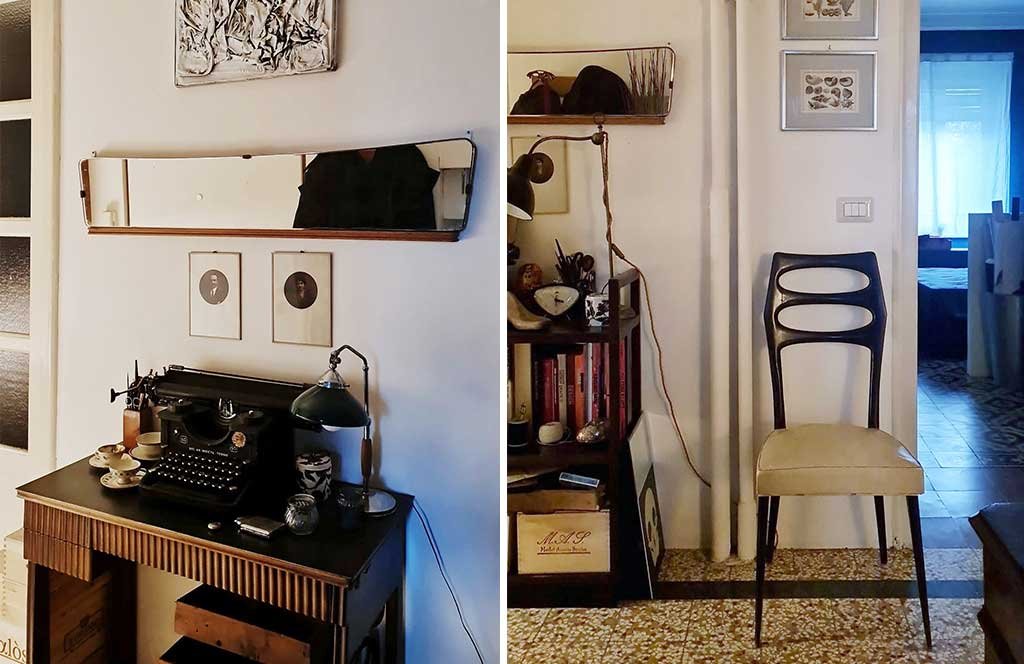
On the left, a small wooden desk with a reeded front, typical of mid-20th-century Italian design, sits atop an old Invicta Torino typewriter purchased from a second-hand dealer. It's accompanied by small objects and a 1940s desk lamp purchased on Marketplace, made of opaline green glass and a brass frame. A unique 1950s mirror completes this charming corner of the home. To the right, the hallway features several furnishings, including a chair—one of three also found on Marketplace—attributed to Vittorio Dassi, produced between 1950 and 1955. Although purchased for a negligible price, they are, in fact, highly sought-after by modern antiques collectors. Their value on the vintage market is estimated at around €500 each.
This apartment masterfully interprets the aesthetic of slowness . The interior layout is classic for the period: double exposure, a central corridor, high ceilings with plaster moldings, terrazzo floors—differently decorated in each room—and traditional cast iron radiators with exposed pipes. To an untrained eye, all of this might appear simply dated. Upon entering, however, one breathes in a suspended atmosphere that allows the gaze to wander along the contours of the spaces, lingering on an infinite series of details left there as a testament to the past that conceived them and that they have silently passed through previous lives.
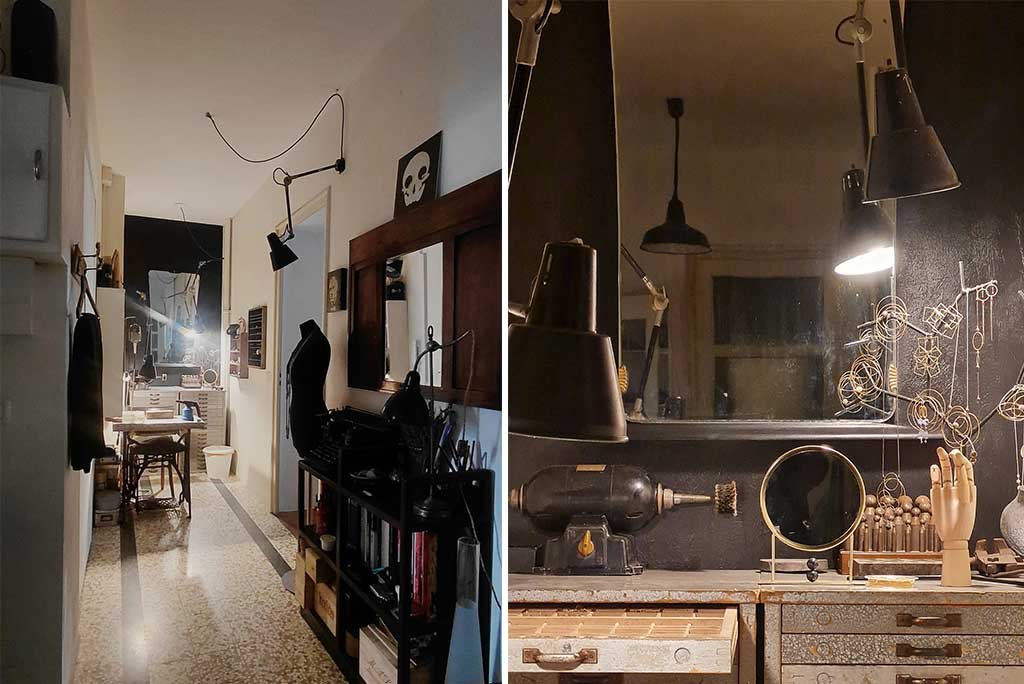
On the left, no space in the house has been left unused: a portion of the hallway has been transformed into a small goldsmith's workshop. The use of black enamel on the walls defines the space where the jewels are displayed. The dark background, in fact, allows for a better view of the jewels, the set stones, and the details of the workmanship. On the right, the 50s mirror completes the workshop's furnishings, amplifying both the light used to work at the goldsmith's bench and giving further depth to the hallway.
Read also →
Second-hand design – hidden treasures
Aside from a crucial false ceiling in the hallway to accommodate the electrical system and a section of plasterboard wall in the bedroom to create a studio space, nothing else was changed. Everything revolved around color—saturated and bold in the chosen hues, even including black enamel for the bathroom and the mini jewelry-making studio.
The geometrically patterned terrazzo floors were cleaned and restored to their original beauty, along with the neutral floors in the hallway, bathroom, and kitchen. The same goes for all the interior doors: plastered, washed, and left showing signs of age . The pipes, as mentioned, are intentionally left exposed : they punctuate the verticality of the walls and create spaces for furnishings, objects, paintings, and travel mementos.
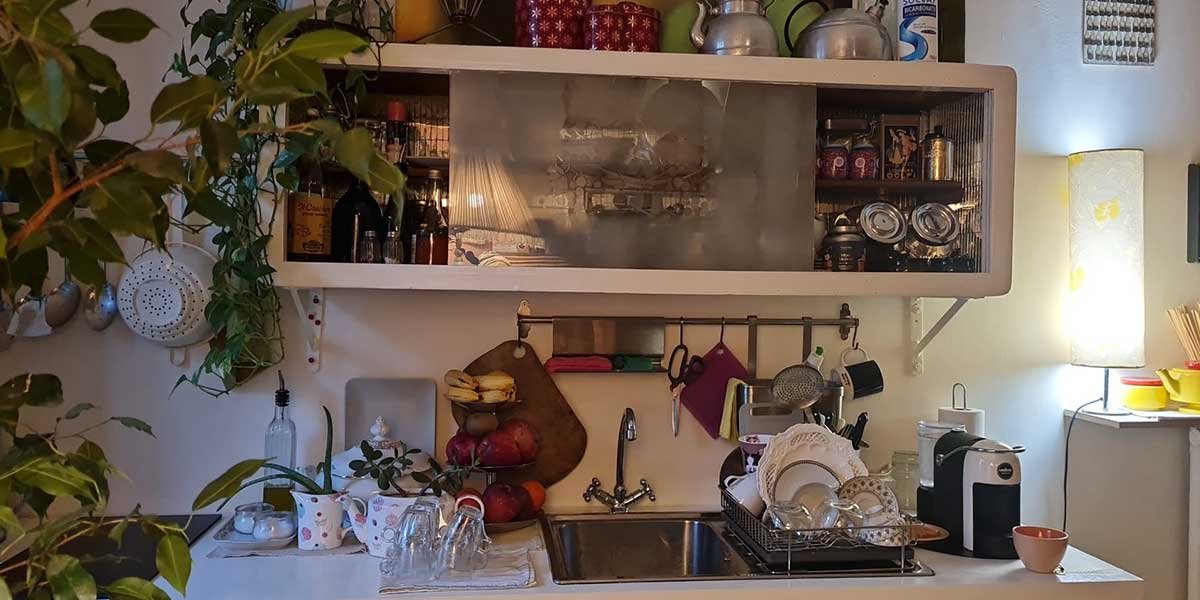
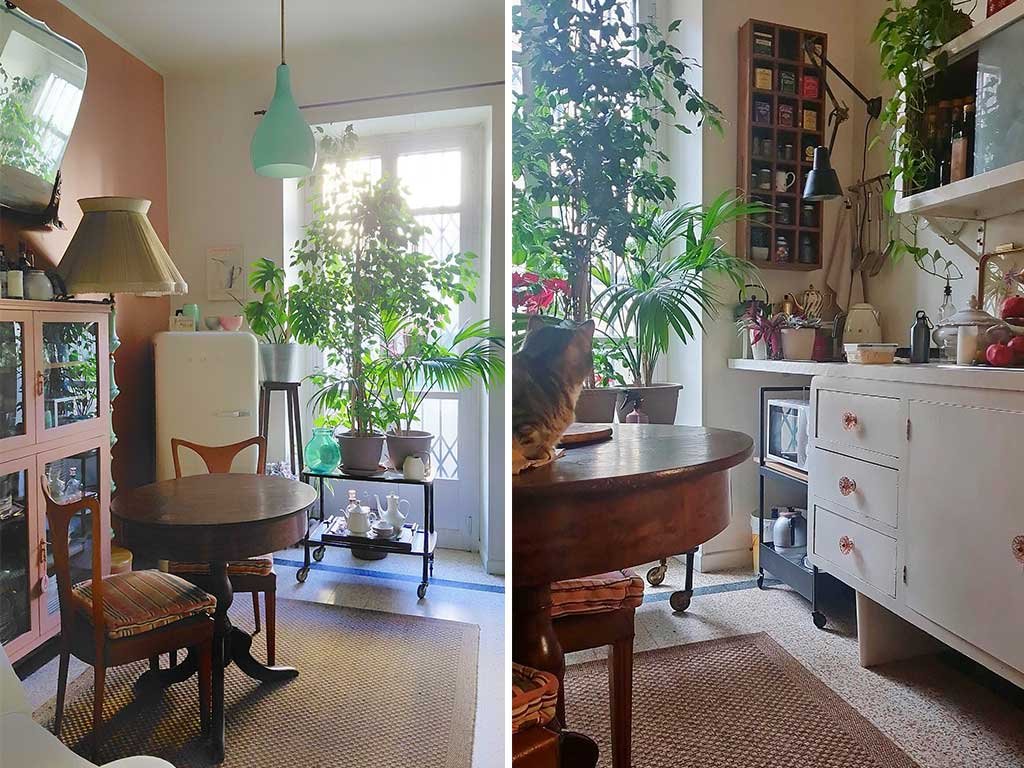
On the left, the kitchen is designed as a private living room, playing on warm shades of salmon and milky white. A small late-800th-century table, purchased for a few dozen euros, is complemented by two 50s chairs found on Marketplace. The chandelier is an original from the late 50s, made of aquamarine Venetian incamiciato glass, purchased from the second-hand dealer Dusty Gold (Solbiate Arno, VA). The floor lamp, with its ceramic and brass stem, onyx base, and pleated shade, is unique. Also dating to the 50s, it was rescued from the landfill and, in a suitable setting, has regained all its allure. In the background, a classic 60s TV cart has been transformed into a perfect plant stand. On a side note, the vintage tilted mirror on the wall above the credenza: a touch of light and spatial counterpoint. On the right, the sink/burner area (with induction hob) was created using an old 50s sideboard, salvaged from an abandoned warehouse. The glass cabinet, with its mirrored mosaic interior, was removed and mounted on the wall with new brackets to provide the necessary height for the work area. The knobs are made of pink printed glass, complementing the salmon-colored wall opposite. A comfortable industrial Seminara pendant lamp completes the kitchen's functional furnishings. A rich and varied collection of vintage tableware and teapots is on display in the kitchen and beyond.
Beauty should not be confused with luxury, which is often an obstacle to true beauty. Beauty can be achieved with simple means and without great expense. People must begin to understand that beauty in life is not just an extravagance; that you work better, feel better, and become more joyful if you are surrounded by beautiful colors and shapes in your home.
This quote by Ellen Key, dating back to 1899, perfectly sums up the spirit that pervades the rooms of this house, in particular the care taken in choosing the furnishings, accessories, and objects that compose its scenography.
Every single protagonist – from chairs to sideboards, from wardrobes to coffee tables, from lamps to tables, from armchairs to chests of drawers, from vases to dishes and fabrics – has a story, the result of fortuitous encounters while browsing second-hand warehouses in the suburbs, the warehouses of old junk dealers, the most modern online marketplaces and, sometimes, authentic street rescues of pieces destined for the landfill.
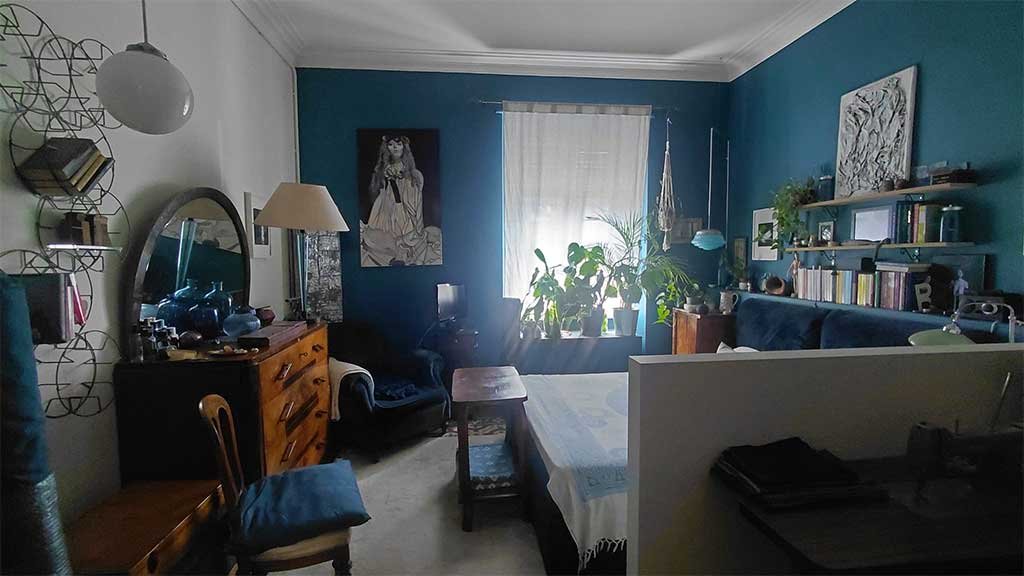
Blue dominates the bedroom, a color synonymous with peace and tranquility. As with the other rooms in the house, it's the details that lend style. Everything follows the same secondhand theme: the beautiful 50s corner pendant lamp with a rigid metal rod and a light blue opaline glass bulb, replacing the traditional lampshade (from Marketplace); the Art Deco walnut radio cabinet beside the bed (from a flea market); and the Art Deco coffee table as a footboard (from Dusty Gold Rigatteria). On the left, a fine example of a 30s-40s Italian Art Deco mirror cabinet, veneered in fine walnut burl and with original brass and Bakelite handles (recovered from a furniture warehouse near Milan).
What counts here is the eye, curiosity, a cultivated sense of taste, and a passion for art, design, and craftsmanship. It's something that can't be improvised; it's cultivated through reading, traveling, visiting exhibitions, and giving vent to an omnivorous, never-ending curiosity for all things creative . It's falling in love with a detail, a color, a shape.
Building slow living spaces takes time. It requires an idea trained to wait, to anticipate the opportunity, to the right moment that will come. Ultimately, it's not perfection, often photographed in prestigious architecture magazines, that matters; it's the pleasure of pursuing it that counts. And in doing so, we live. Fortunately, nothing is static.
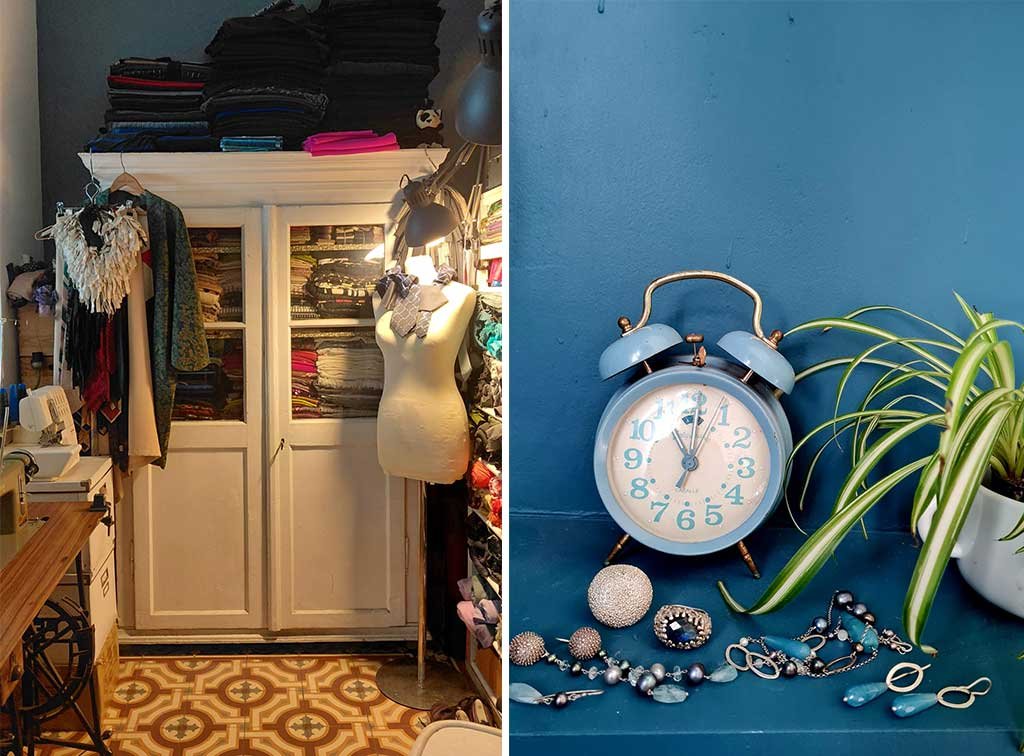
On the left, the bedroom also features a small fashion atelier displaying the designer's fabrics, yarns, and patterns. On the right, every single item is a collector's item, like the vintage alarm clock purchased at Dusty Gold Rigatteria for just a few euros. In the foreground, some jewelry from Glix Atelier.
Estrid Ericson wrote in her 1939 Catechism of Interior Decoration : "We must never forget to cultivate freedom within our homes, not to give up objects just because they might compromise our aesthetic formalism. It is never a pre-established color scheme that gives a home its personality, but all the things we collect over the course of a lifetime. All the things we once loved, along with all the things we love today. Our homes are never complete. Throughout our lives we continue to build them . "
The cover features a view of the kitchen counter and display cabinet above, in a retro-style Turin home. Each piece of furniture is the result of careful research at flea markets, aiming to combine savings, reuse, and creativity. The results are truly charming.










2 comments
Congratulations on the article, but my appreciation goes to the artist I know personally, who creates unique and elegant jewelry and who has made her home a place to be admired.
Beauty is not for everyone
Mara, thank you. I'm glad you enjoyed the article, and since you know her, please offer my compliments to the artist. See you soon!