

by Sara Gecchelin.
Renovating your home without renovating is possible: sometimes all it takes is a painting to change the atmosphere of a room and infuse it with personality. At a time when color is once again taking center stage in interior design, painter Elisa Munari guides us to discover the emotional value of art in living (and we'll give you some helpful tips to help paintings create harmonious connections in your spaces).
Interior design means finding the right balance between comfort and aesthetics to achieve harmony in a space. In this process, a painting represents much more than a decorative detail; it often becomes a focal point of the room, reflecting not only beauty but also your sensibility. While furnishings define the functionality and style of a space, it is often art that gives it soul, combining with furniture, fabrics, colors, and lighting.
THE EXPERT'S WORD
To orient ourselves in this world, we asked artist Elisa Munari , a leading exponent of contemporary lyrical abstraction, for her opinion. Through a perceptive style based on glazes and liquid acrylic fields, her canvases depict imaginary landscapes brimming with vibrant energy , capable of piercing the wall to connect space and interiority. Here is our interview.
Elisa Munari is a self-taught artist whose practice lies within the realm of contemporary lyrical abstraction, where color becomes a tool for inner exploration and perceptual transformation. Photo courtesy of Elisa Munari.

How can a canvas or a painting transform a space from a simple furnished space into a place that tells a story and reflects the soul and emotions of those who live there?
In my painting, the canvas becomes a threshold, a space that contains and transmits. When I paint, I don't do it with a mindset of what to paint, but with the intention of bringing new energy and openness to those who can receive it. Color guides my hand; I simply follow the process and let the colors emerge in the painting. In this process, I realize that elements like lines, stains, and fields take on a form that isn't mentally sought, but simply embraced and embraced. In this way, emotions, feelings, memories, and visions emerge.
I believe that every painting created with purpose and emotion can be transformative, both for the environment and for the person who chooses it, or for those who simply observe it. For me, colors are energy and frequency; each color transmits something and reflects what each person feels and perceives. For this reason, in a home, a painting is no longer a simple accessory or furnishing element, but a threshold, a gateway, an opening to what each person's inner self perceives and is able to discern.
"Thus, in a given setting, this painting tells the story of its inhabitants because it's no longer my personal emotion that emerges, or what I felt while I painted it, but what the person inhabiting that place is feeling. Colors are like musical notes that, mixed in various ways, create harmonies and musicality."
A painting enters a space not just as decoration, but as a living presence: an element that can influence energy, raise frequency, and open up a new vision. Photo courtesy of Elisa Munari.

How can a work of art interact with the surrounding furnishings without overpowering them, but rather enhancing the entire space?
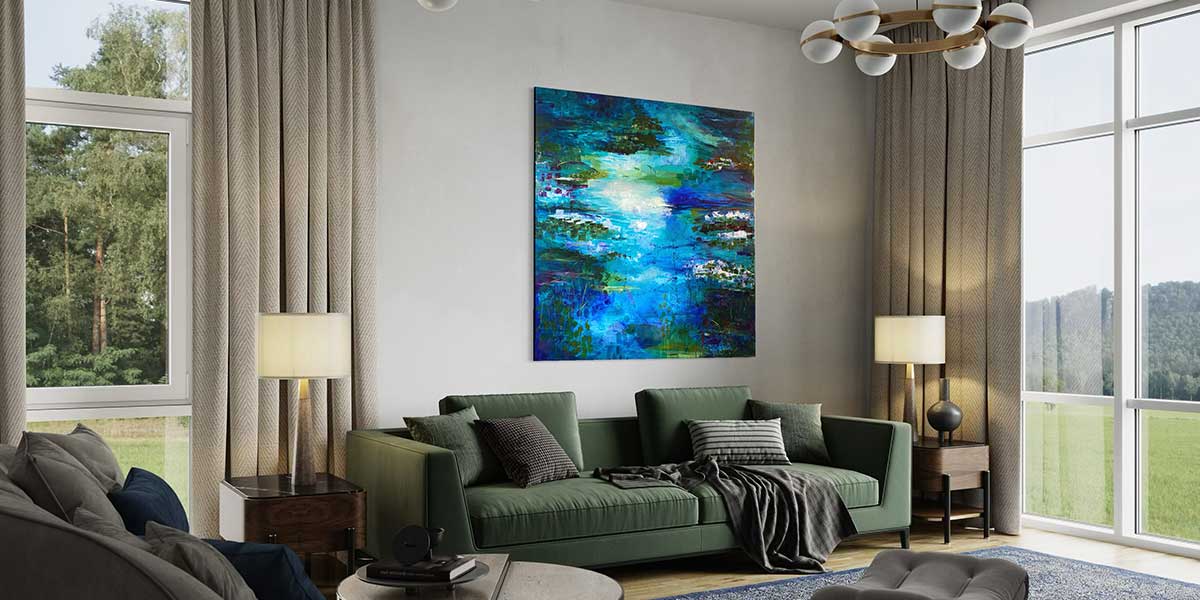
A work of art must above all be a conduit, a bridge between invisible emotions and what exists in reality, in matter and in the environment . When a painting manages to be all this, it begins to dialogue with the surrounding furnishings, precisely because it carries within itself what can emphasize them rather than cover or overwhelm them. When a space needs light and openness, a painting that conveys color and harmony naturally amplifies it, giving it strength and balance. My Portals of Light paintings can be all this and fit into the most diverse spaces, even the bathroom or kitchen.
Many people love paintings but are afraid of making the wrong purchase. What's your advice for a design enthusiast looking for the perfect canvas for their home?
My advice for choosing a work of art is to let the work itself choose you, not the other way around. I believe there should be a sort of love, a deep feeling that guides you in identifying a piece that would be perfect for that space. Consider the work of art as something that can choose you, can fall in love with you, and you with it, and let it choose the space it inhabits: be it the dining room, the bedroom, the living room, or the bathroom. Art must always be the link between Spirit and Matter, between emotion and environment, between interiority and rationality.
In Elisa Munari's work, landscape is never a place to be depicted, but a space to be traversed. Natural elements like water, light, and vegetation emerge and dissolve in a dimension that is not descriptive but experiential. Photo courtesy of Elisa Munari.

A QUESTION OF HARMONY
Evaluate the painting's style, size and proportions
We agree that choosing a piece—as the artist explained—must be a thoughtful decision, but it's also true that, from a practical standpoint, its placement requires attention to the visual relationships established with other pieces in the space. What should you pay attention to, then?
- Evaluate the style of the painting: abstract, landscape or geometric, it must still be able to dialogue with the surrounding design, to create stimulating contrasts or relaxing synergies.
- Consider size and proportions: they are strategic for enhancing the perception of a space. Remember, for example, that a large vertical canvas makes low ceilings appear slimmer, while small paintings add dynamism to the spaces.
- Finally, let yourself be guided by the light: whether natural or artificial, it is the decisive factor to best emphasize the chromatic nuances of the painting.
Read also →
The art of decontextualizing
THE OVERALL VISION WINS
Don't concentrate too many main pieces in a single room
Beyond the rules, this dialogue with art leads us to consider a deeper concept of interior design. Regardless of the number and type of objects (furniture and furnishings) we decide to include in a room, the reality is that only harmony as a whole can create a truly balanced living space . Achieving this result is not impossible, but we must avoid centralizing too many pieces that individually capture attention . And it is precisely in this situation that paintings, with their color palette and expressive power, reveal a crucial role. If you don't consider them an isolated element, but a visual bridge, the canvas can connect different characteristics —the style of a piece of furniture, the tone of a wall, the texture of a fabric—enclosing them under a single, coherent overall vision. Art, after all, doesn't decorate: it unifies.
Elisa Munari's work offers interesting food for thought: the beauty of art speaks to everyone directly and immediately; it doesn't come from the mind, but from instinct and the subconscious. Everyone naturally senses what makes them feel good, even in the space they live in. Photo courtesy of Elisa Munari.

BEYOND THE FEAR OF PURCHASING
Invest in art, but one painting at a time.
The idea of purchasing a fine art painting can often be daunting, due to the widespread fear that it's financially inaccessible or, worse, incomprehensible to those who aren't true experts and therefore can't grasp its deeper meaning. Overcoming this barrier through one purchase at a time is the best way to introduce art into your home. You don't need to start by investing in a major work; you can even start with a small painting that evokes a feeling. Allowing this very detail to become, day after day, the most personal expression of your home experience can make it a place of order, not only in terms of space, but also in terms of emotions.
On the cover, "Portals of Light" by Elisa Munari. These paintings are powerfully energetic: vibrant surfaces in which color acts as a frequency, activating emotional resonances and moods. Photo courtesy of Elisa Munari.