

An interview by Evi Mibelli with Daniela Pinotti.
“I am a nomadic soul and always looking for change.”
A special meeting, the one with Daniela Pinotti. A lively, open mind and a gaze that lights up when he talks about his passion for design, research, and experimentation. Her restlessness seems to arise from the fear of having more ideas than she has time, and this makes her concrete, direct, and precise. Her life—and not just her textile art—is a hymn to movement, to the ability to find connections between different worlds and thoughts.
Her coherence is measured precisely in her refined ability to intercept unexpected meeting points and transform them into opportunities to experiment with new expressive languages. Which is the way to give uniqueness and identity to her work. Daniela Pinotti is a textile designer, one of the most interesting on the Italian scene in recent years.
Carnet de Voyage, installation for Open House Exhibit, Rome 2023.
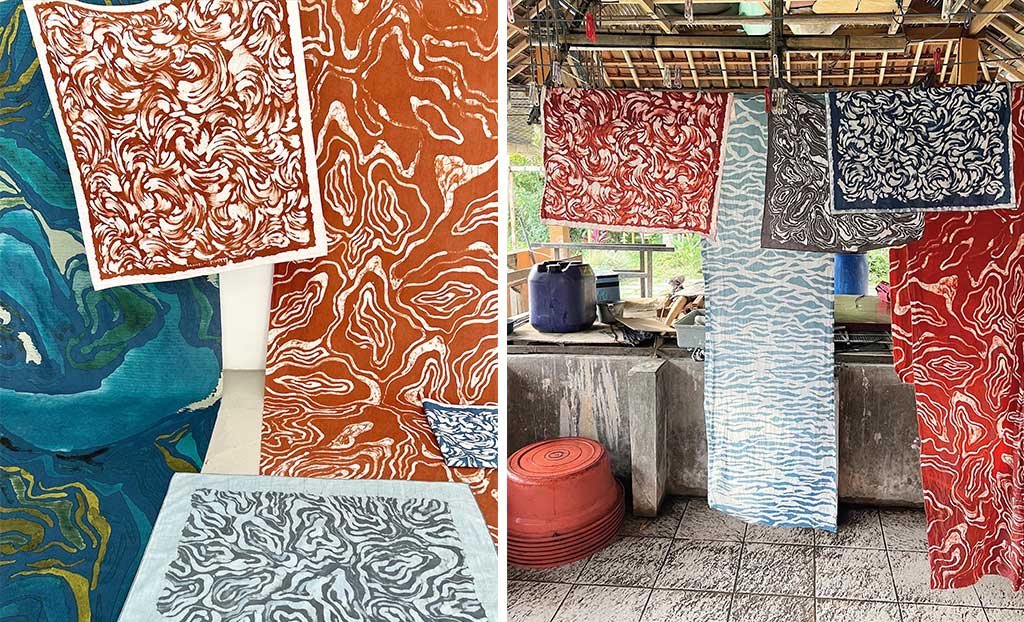
Fabric is the medium she chose to express her creativity. She experiences it as a ‘journey’, a sort of map that tells the story of geographies, thoughts and cultures. And, in fact, her training is tangible proof of this.
“Yes, at the moment fabric is the form of expression that is most congenial to me, leaving me great creative freedom. I don’t know if it will always be like this. I’m open to new stimuli that can change the status of my work and push me to have different experiences. I began my studies with an interest in fashion. And in fact I graduated from IED in Rome, in fashion design. From my very first work experiences, however, I developed a strong predilection for the development of graphic representation for print, rather than for model design. I basically trained to do a certain type of activity, and ended up choosing a different path. My career is an example of continuous changes and discoveries.
I worked as an employee for several years, starting in a fashion atelier in Rome, then moving to Treviso to work for Benetton. Given my difficulty staying in a fixed context, I decided to leave Italy and move to Sweden, where I had the opportunity to live in a completely different dimension, truly formative. Finally, I returned to Italy while still maintaining a strong connection with Stockholm.
All this to say that my understanding of fabric occurred gradually, moving from printing – which remains one of my favorite forms of expression – to experimenting with jacquard fabric and learning about actual weaving. Sul tessuto e con il tessuto si possono fare talmente tante cose che, davvero, è difficile vederne i limiti”
Stillmoving, digital print on voile. Textile installation for the group exhibition Still Moving, curated by Label 201. Design District Portuense 201, Rome 2019. Photo © Serena Eller for Eller Studio
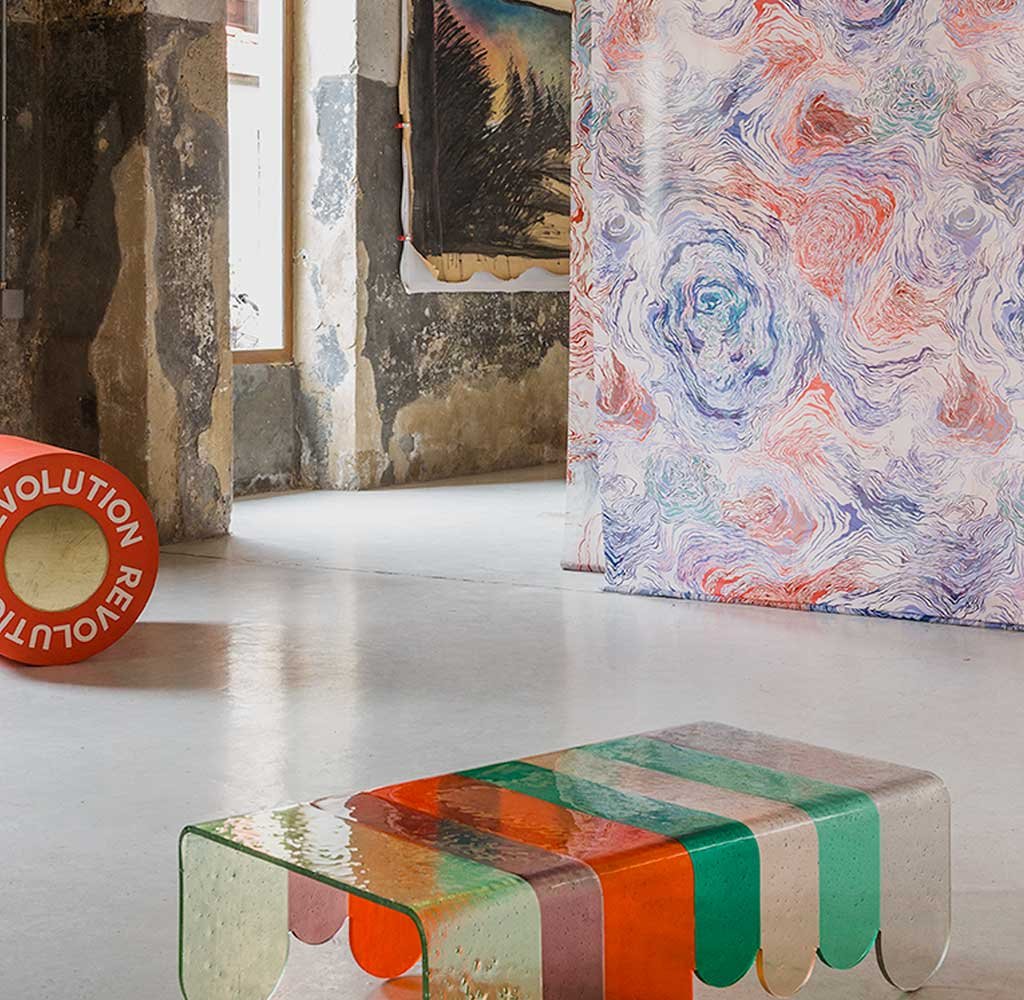
In 2016, upon returning to Italy, she founded her own textile design and fashion consultancy studio. Collaborations thus came to life with important brands such as H&M, Benetton, Napapijri, GANT, and with textile companies such as S.E.T. and Gruppo Miroglio.
“Today I work on multiple projects at once because my creative energy expresses itself better when engaged across multiple tables. Dedicating myself to just one project at a time turns me off. This is why I started working freelance in 2016, developing my work between Italy and Sweden, in a very stimulating creative nomadism. At the same time, I began to self-produce my ideas and collections: scarves, wallpapers, fabrics, collaborating with other studios and professionals. All this has led me, starting this year, to think of myself in a more nuanced way. A kind of holistic, 360° creativity. In a certain sense, I have the desire to move away from the traditionally understood textile to explore other creative fields that can – ultimately – lead me back to textiles but with new interpretative keys, working with different materials that are foreign to the world I know.”
ODE silk scarf collection, inspired by the colors of Nordic nature. Limited edition. Photo © Cristina Crippa
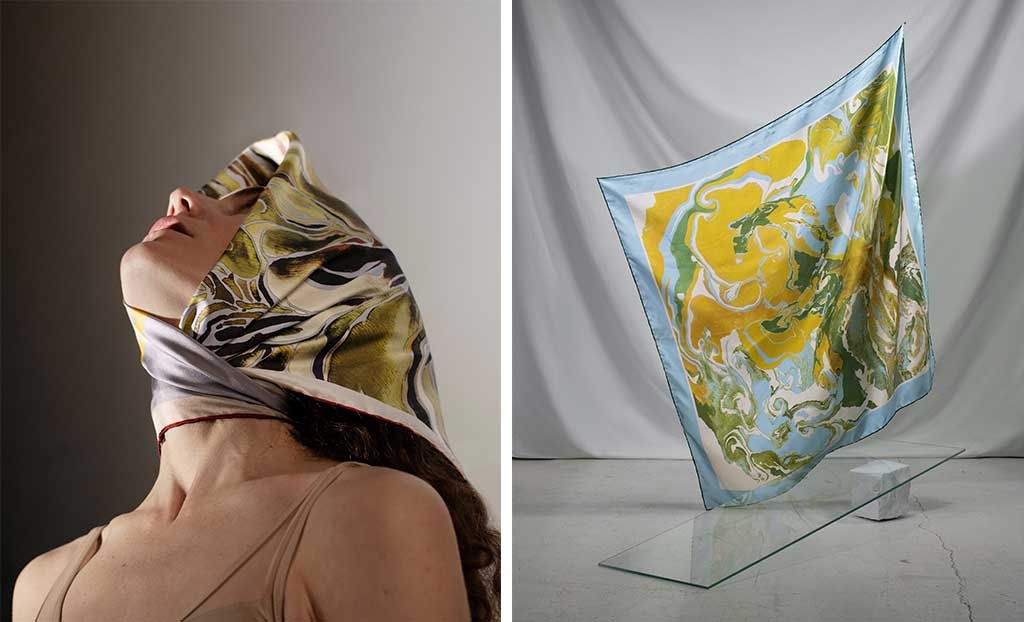
The relationship with Nordic textile design remains a cornerstone of Daniela Pinotti’s expressiveness and it is easy to find references to it.
“La Svezia ha avuto una grande influenza sul mio lavoro e ce l’ha tuttora. In Sweden, the topic of fabric printing is very present among designers. In Italy it is perceived differently, we are more tied to the three-dimensional – or at least that’s my perception. Nordic designers are more conceptual, they are more interested in the idea behind things. In my work I try to mediate between the two cultures, using contrast and differences as a creative source. In Italy, we are more culturally bound to beauty and well-made things and less inclined to experiment freely. I have made their way of creating and subverting the rules my own.
In my first collection of self-produced objects—limited-edition silk scarves made with a Como-based silk company—the inspiration came from nature and the Nordic colors I’m deeply attached to, expressed through an abstract language. The pattern met the beauty and uniqueness of silk, a fabric closely linked to our history and the world of luxury. The result was surprising. This game of references is recurrent in my work.”
Collection Quattro. Fabric understood as structure and identity, as movement and fluidity. The collection consists of four furnishing elements. Photo © Tania Alineri
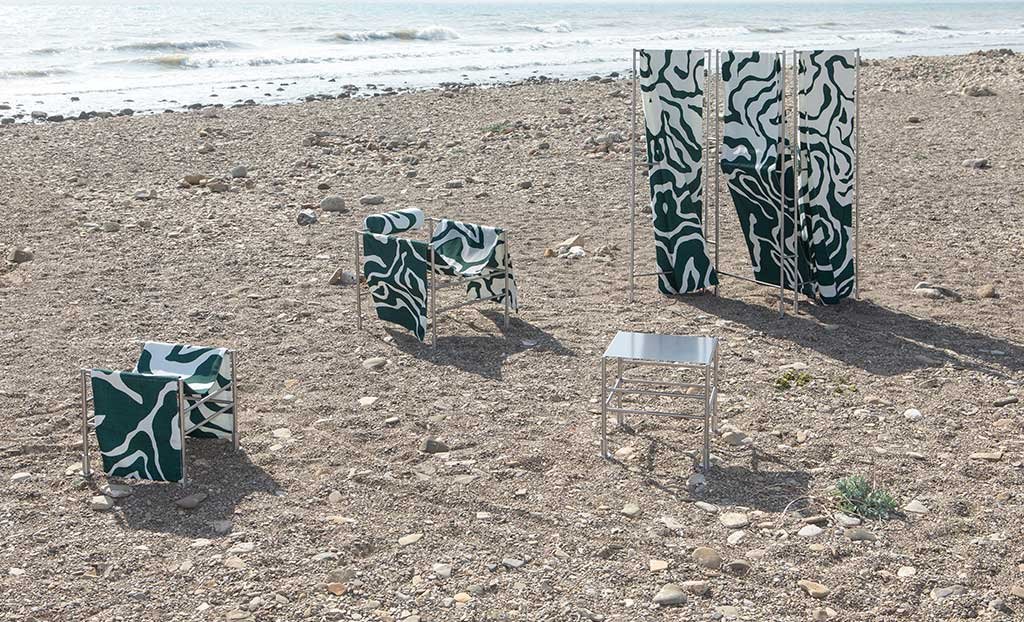
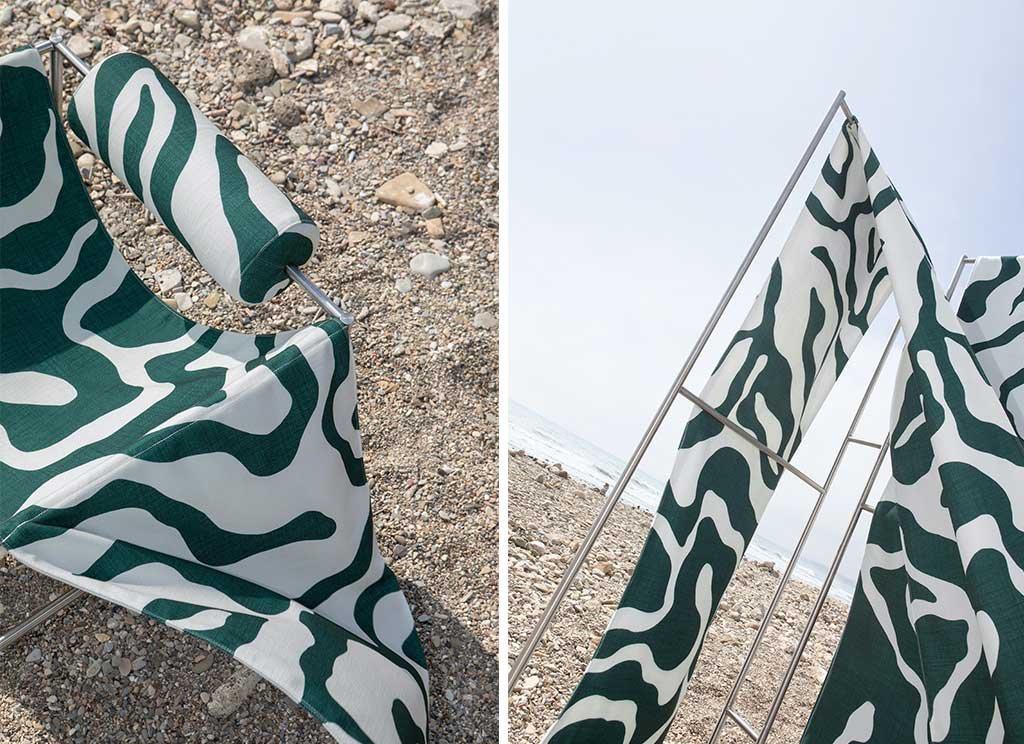
The fabric offers not only two-dimensionality – which is typical of printing – but also the more sculptural and three-dimensional one deriving from the weaving and interweaving of the yarns used. È un aspetto di ulteriore arricchimento e opportunità di espressione.
“I sought three-dimensionality not only through the interweaving of yarns, but above all in the use of fabric as a ‘constructive’ element. This is evident in the Quattro collection, recently presented in Naples. The simple steel structures of the furnishings have no functionality, deprived of the fabric. It is the latter that gives the furniture its identity and, above all, its supporting function. I thought of fabric as a material that takes shape in space, and it is unusual in terms of design, because fabric does not normally assume this type of role.
There was a very thorough research both at the supplier level and for the necessary technical properties of the fabric itself. A layered project where, in some phases, it was specially hand-painted and then digitized for printing. This is to give balance and aesthetic coherence to the entire collection.”
Fabric, therefore, becomes an element that can define – by extension – also a space, an architecture. It is the way it is used that establishes its function. A concept that expands its traditional role as an accessory, transforming it into something structural.
“A carpet is woven, a curtain is woven, a tapestry is woven. Depending on how you think about it and place it, it defines a space. A curtain, for example, not only screens the light, it modulates and modifies it to the point of altering the chiaroscuro of a space. The tissue can live independently. A project I’m doing in the studio involves the use of canvases that act as space dividers, replacing walls. Con il vantaggio della leggerezza e della possibilità di cambiare posizione, all’occorrenza. But it also has a decorative role. I like to deconstruct, simplify, and arrive at a synthesis. I prefer to think of fabric as a structural element of an object or a space, and less as a pure covering”
Daniela Pinotti’s laboratory space, Rome. Photo © Lara Cetti
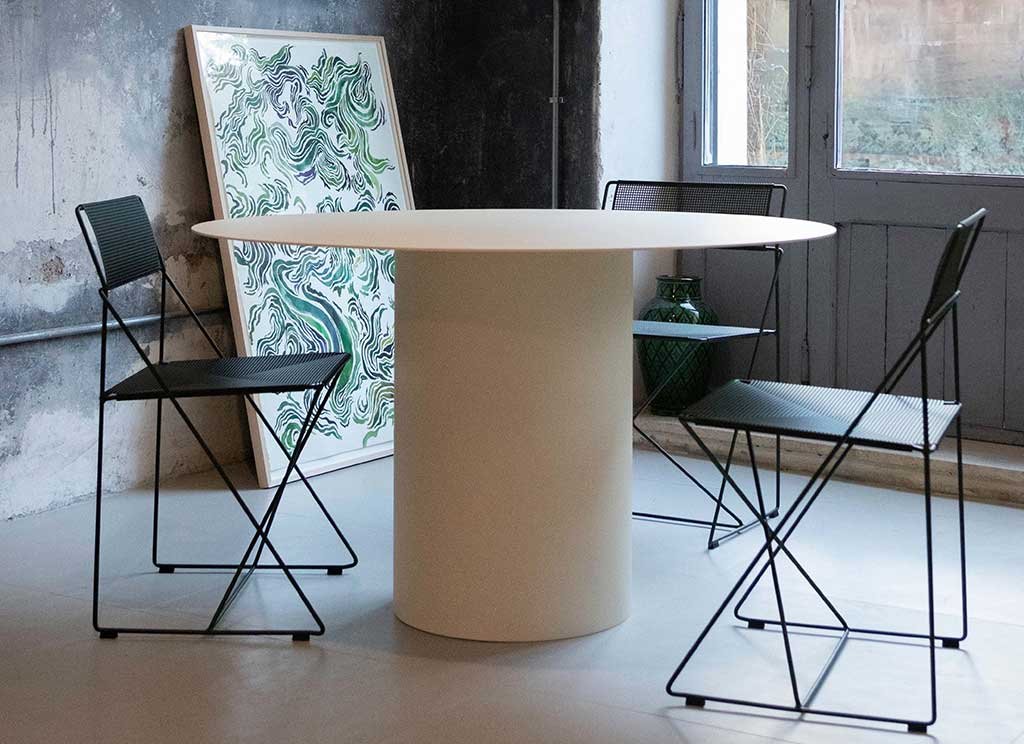
The theme of exchange is central to Daniela Pinotti’s design vision. To the point of being the fulcrum around which he is building his design hub, a place that is simultaneously a laboratory, workshop, showroom, art gallery and cultural space.
“I find the theme of exchange, of forays into unfamiliar territories, fundamental to my work, and I believe we can forge exciting collaborations with other worlds and other creatives. All this led me to find a larger space—which I’m designing and which—in my intentions—should become a sort of crossroads of ideas, proposals, and projects. Obviously they must have their own coherence with my way of feeling the project, but in any case free expressions. Furnishings, fabrics, curtains, lamps… A mirror of who I am creatively. But it is also a welcoming place for ideas and projects coming from other voices.
Una nota importante: quasi tutti gli oggetti avranno le ruote. It is the vivid representation of my nature: after years spent travelling without putting down roots, I felt the need to ‘stop’. But without betraying my nomadism, my staying in balance, in the instability that serves as my stimulus because without it I can’t breathe.
I see this space as ‘in progress’, always moving from now and in the years to come. Here is my laboratory, my production area (carpets, tapestries, curtains) but also space for installations, events and workshops, training courses. I see it as a hub for the arrival and departure of ideas, people, and projects. Even if they are not related to my work but which share my same need to experiment and challenge myself. A meeting point between designers, clients and companies. A factory of ideas, but also of concreteness”
An approach confirmed by the collaboration with STUDIOTAMAT. A textile installation project, born free from the constraint of reaching the ‘market’ with a finished product following positioning, production process, and marketing logics.
“The goal was to study the process, how to arrive at a concrete creative idea, in self-production. It is a theme that requires other logics and other paths of development and visibility. The result was a fabric that I designed for STUDIOTAMAT, which the OPIFICIO company produced and subsequently acquired for its collection. He has toured various events and shows, starting with Milan Design Week, during the Salone del Mobile, and then moving on to other locations around Italy. Quello che è significativo di questa esperienza è che un tessuto – e in generale il progetto – acquisisce visibilità e identità attraverso gli eventi che vive, le forme che prende, i luoghi che occupa. It is how it is seen, perceived and ‘set up’ that transforms it into a product”
The theme of self-production as an opportunity and alternative to the constraining logic of industrial production appears to be the way to ensure the freedom to experiment. The question that arises is whether it is sustainable.
“There is no answer. It is essential to take into account one’s own possibilities and the opportunities that arise. Diciamo che la parte di sostegno alla mia attività proviene, grazie al mio passato di progettista alle dipendenze di aziende del settore moda – dalle consulenze che continuo a prestare e dalle quali, peraltro, attingo comunque spunti e idee per le mie produzioni. Self-production is actually a rather difficult and challenging field in economic terms. It’s a niche market and it’s difficult to create a distribution network.
From my point of view, in Italy, there is not adequate support and promotion for activities such as design. The difficulties begin when you want to rent a laboratory. There are no concessions. Or if you intend to produce your own project, companies rightly set production minimums that, however, prove unsustainable for the creative. They are not interested in research, in projects unless they are by famous designers. The worth is in the brand name. How much does it cost to create an independent design network? There is no single answer. I am looking for my answer with this laboratory space in which I work and in which I have invested, where I intend to bring together more activities, exchanges and experiences capable of being a ‘network’”
OFFTAMAT, an exhibition format in the heart of Rome’s Prati Design District. The fabric made with the lampas technique is made of natural yarn, with particular attention to sustainability and the high artisanal quality of the product. The High Ride collection went into production with the Opificio company in 2025. Ideal for multiple applications: from upholstery to curtains. In collaboration with Studio Tamat. Photo © Serena Eller, Eller Studio
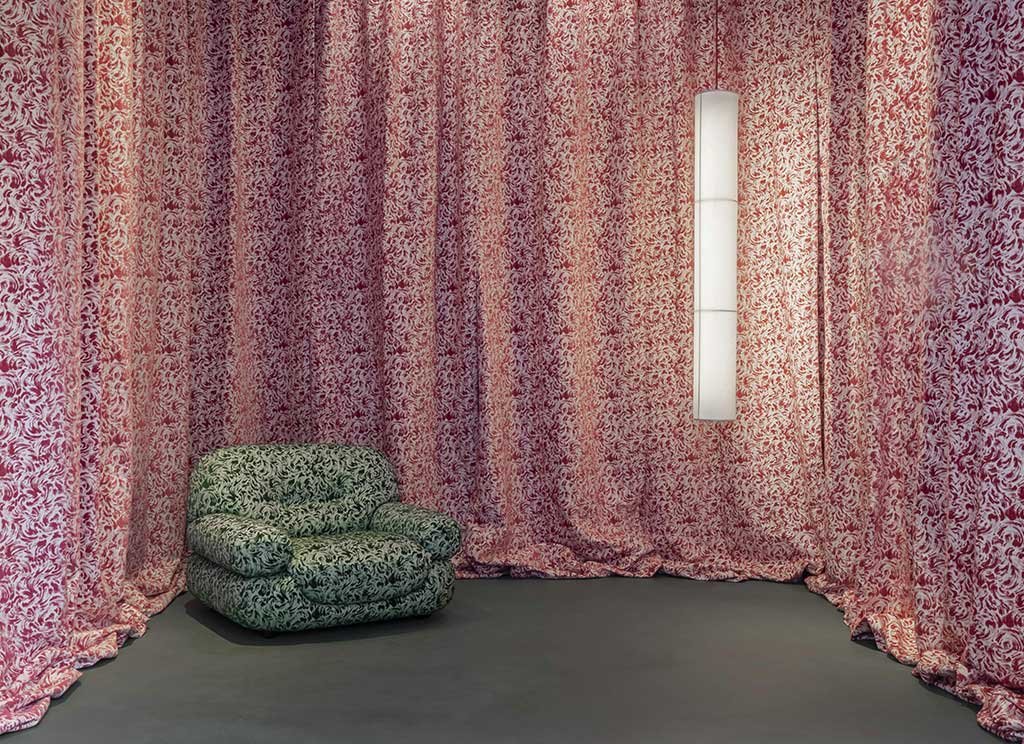
Sustainable design, rediscovering traditions.
“ There is no single way to be sustainable. I always create a link with natural imagery in my work. And when you work on self-production this concept is even more present and leverages not only the principle of recyclability, but also the ability, for example, to use local materials.. È un concetto ampio, dipende dal progetto. Always thinking of travel as a research experience, meeting local artisans and producers is for me a harbinger of emotions and discoveries.
Not long ago I visited the Seterie di San Lucio (Caserta), a spectacular factory of the highest quality. The problem with these companies is that they are losing market share. They only retain a few historical clients and do not have the strength to renew themselves. And, in this, they are not even supported by concrete policies of valorization and relaunch.
Then there is the problem of generational turnover which condemns us to oblivion. What a shame. Come designer credo sia importante conoscere queste realtà, acquisirne le tecniche per poi accompagnarle verso interpretazioni progettuali più attuali. This is why I have the idea of bringing workshops into my space, precisely with a view to learning about and experimenting with artisanal heritage that risks being lost.”
Transformation, fluidity, nomadism, identity. Daniela Pinotti is movement. She’s never where you see it. She’s already elsewhere.
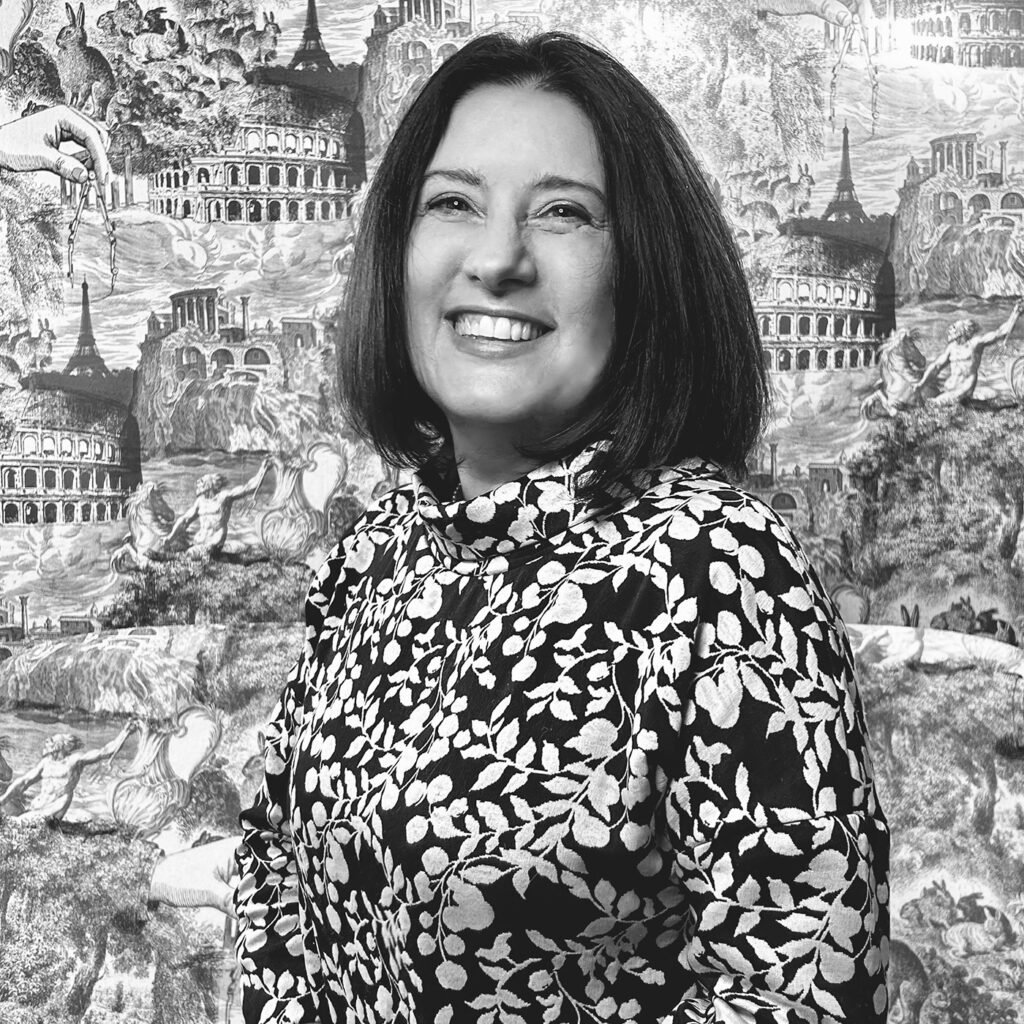
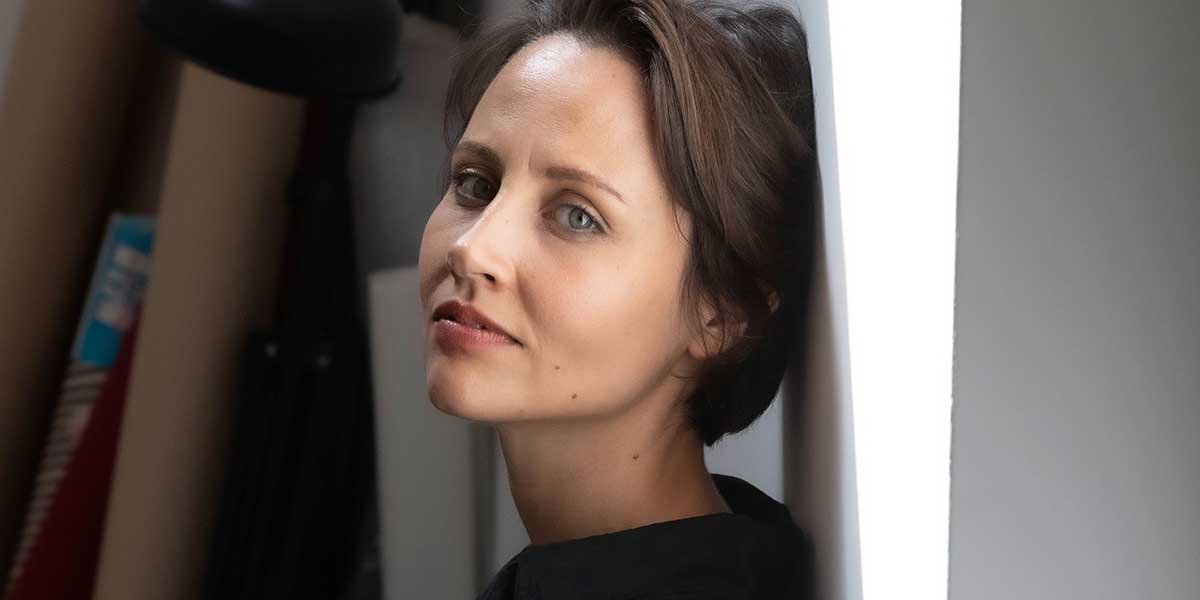
On the cover, Daniela Pinotti, photo © Lara Cetti
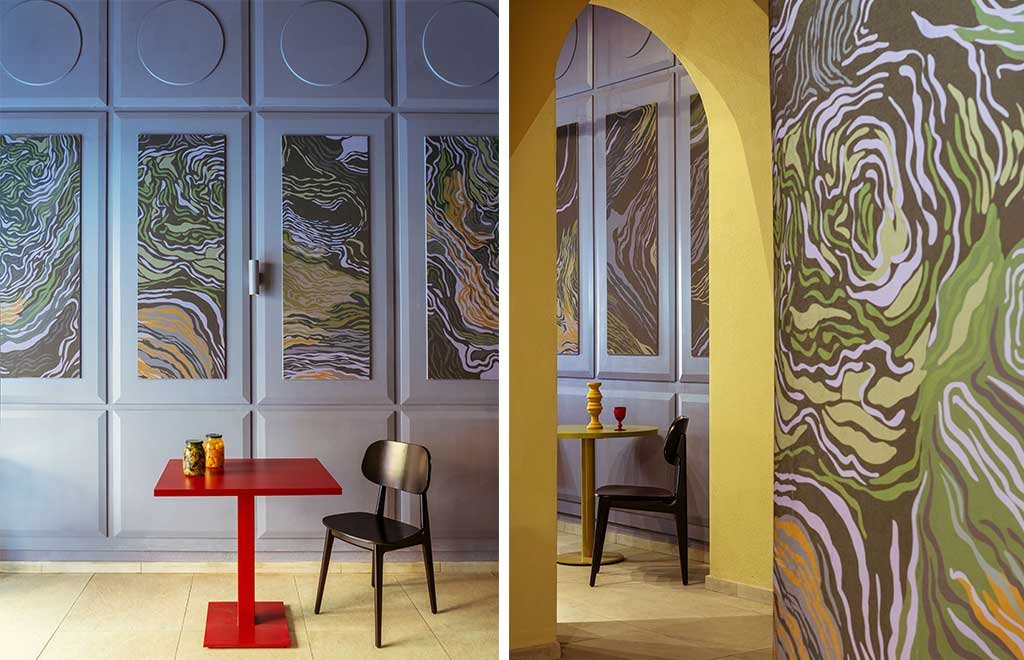
Layers, wallpaper collection for STUDIOTAMAT The collection was created for the interiors of the Ardecore pizzeria, inaugurated in 2024 in Rome, photo © Daniele Criscenzo