

An interview by Anna Caldera with Olivier Roset, Co-CEO | General Manager of Groupe Roset, which encompasses the Ligne Roset/Cinna/Ligne Roset Contract brands.
The past determines the future when we have a farsighted vision of the present, seizing its opportunities, giving space to the creativity of new generations and (at the same time) carrying forward the traditions capable of making a real difference.
A name that has made the history of international interior design, an emblem of “Made in France” but, above all, an important history, born in 1860 and which has maintained production in the heart of Bugey and in the five factories located in the Ain, Isère and Rhône regions. Tradition, craftsmanship, and, without a doubt, a romantic and productive determination to understand and adapt, with intelligent promptness, to the changing times: Ligne Roset is all this, but it is also a great, choral, heartfelt family story. A passion that is passed down from generation to generation.

In his century and a half of activity, he was able to understand the conceptual path that – especially in the post-war period – laid the foundations of modern design, discovering the importance of ergonomics and methodology, bringing out the great names we all know and creating products that entered the collective imagination.
During the last Milan Design Week, I had the opportunity to discuss this epochal transformation, fascinating and inspiring in many ways, with Olivier Roset, co-CEO of the Roset group (Ligne Roset/Cinna/Ligne Roset Contract) and direct descendant of its founder. A long chat, in which we discussed a unique and unrepeatable historical period, the birthplace of the style we now consider contemporary and representative of our time. We then returned to the present day, to the respect for traditions and his personal thinking, to the creative and corporate vision always projected towards the future.
Olivier Roset Co-CEO | General Manager of Groupe Roset, which includes the Ligne Rose/Cinna/Ligne Roset Contract brands.

Il vostro è un nome riconosciuto dell’interior design: partendo dagli albori della maison, quali sono stati gli snodi fondamentali e determinanti per il successo di oggi?
“After the Second World War, a true cultural revolution took place, a rebirth from the ashes of destruction, the beginning of a new world. Design was a way to interpret society, to create new perspectives. It wasn’t just about form, but about new uses and ways of experiencing objects. It was during that period that my grandfather, followed later by my father and uncle, developed the idea that still determines the success of our products today: uniqueness but also accessibility, comfort and versatility. All seasoned with artisan craftsmanship and a distinctive, unique and never seen before style”

The transition from the 1950s to the 1970s therefore marked a turning point.
“Social changes, aesthetic and intellectual revolutions have only ever inspired new visions. People wanted light, removable, dynamic products. It wasn’t just a thought devoted to aesthetics or a stubborn search for modernity, in contrast with lines considered ‘old’. It was a desire to experiment, a shared idea: abandoning the past, its symbols and lines that recalled a bygone era, relying on young designers, even unknown ones, to break with the previous generation.”
Yours was certainly a clear vision, in step with the times, while maintaining, unlike others, the respect for craftsmanship, which has always been a hallmark of your brand: looking to the future but carrying forward the excellence of the past. I’m telling you this because Ligne Roset is famous (also) for its in-house and well-structured production, in some of its phases totally handmade.
“It’s true: today many brands no longer create anything or almost nothing independently. We do. We produce everything: sofas, furniture, accessories. From a design perspective, to a structural one, including padding, textiles, and more: the entire creative and production process. And we do it in Briord, 70 km from Lyon, in five factories, with over 800 people. It’s a team effort, a community effort. Many of our artisans are children and grandchildren of those who worked here before them”
Those who work with Ligne Roset often do so for life.
“The average tenure of our employees within the company is 35-40 years. A very rare thing, which we are proud of. Ligne Roset is not just a brand. It’s a community. It’s a cultural project, even before it’s an industrial one. A family”.

Confirming this spirit, the company has created a museum, a training center, and a showroom right next to its factories.
“Everyone should have the opportunity to discover and see what we are creating. From visitors to the people who work with us, to convey the very spirit of the company, its deepest soul. Internally, we involve everyone in the different aspects of production, to make them understand what we are achieving together. Let me give you an example: we also invited our employees to the Palais de Tokyo, the brand’s annual event in the temple of contemporary creation in Paris, which brings together the entire community of Ligne Roset customer-employees to share with them our vision from production to sales.”
Another strength of the company is sustainability, not dictated by marketing but as a real resource.
“We don’t throw anything away and we encourage our customers not to do so because our historic products can be restored by our craftsmen. If they bring back an old sofa, we fix it up, reupholster it, and it’s as good as new. The structure is good, the hands that created it are still here. The factories and their workers remain at the centre of the project, always”

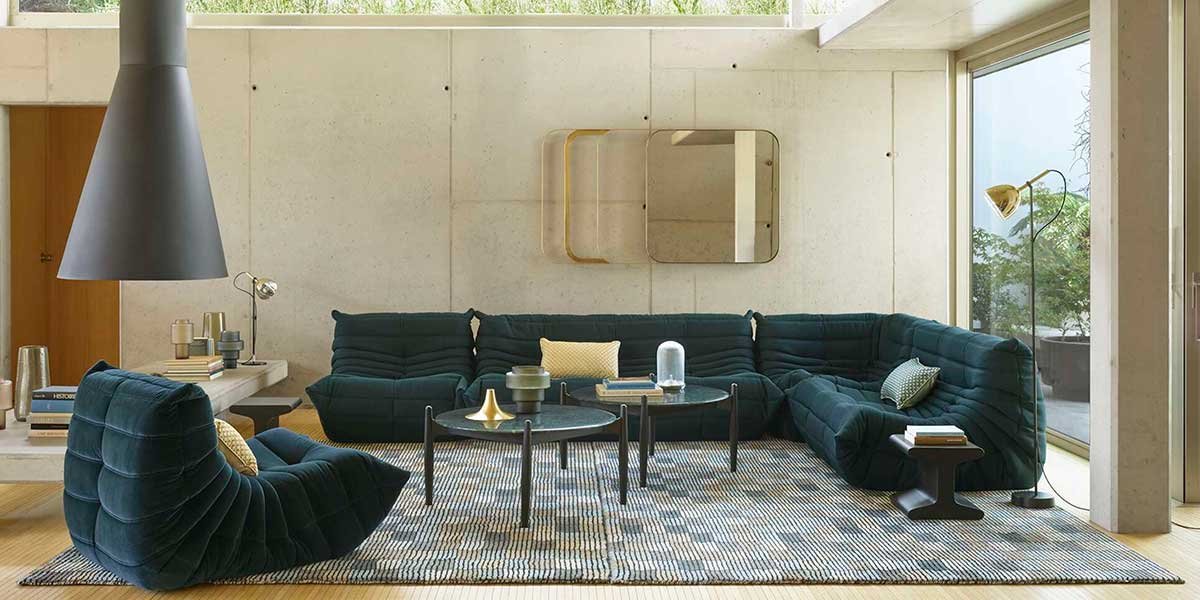
Returning to the production that made you famous, one of the absolute icons is Togo, the celebrated sofa with its soft shapes and no rigid structure. An emblem of design and craftsmanship. An emblem of design and craftsmanship.
“It was born in 1973 to Michel Ducaroy, along with my grandfather, my uncle and my father. A courageous creation, possible only thanks to the total trust between a visionary designer and a family willing to take risks. At first, retailers didn’t understand it, they said: ‘it looks like a crushed tube of toothpaste’. It had no legs, it was too light, too different. But it resisted and became an icon.”.
If one asks “when” the public really began to understand this, the answer seems clear.
“The turning point, without a doubt, came with the change in mentality of the new generations of the time, who did not want the style of their parents’ furniture. They were looking for something more comfortable, less formal, with an innovative design and not tied to the past. It was precisely in those years that a new taste emerged through the minds of designers who made history, marking a new chapter in style. The same ‘style’ that, still today, inspires us and allows us to re-edit models from fifty years ago that have maintained the freshness of the original idea intact. Perfectly integrated with contemporary production that creates new proposals every year”.

Taking inspiration from what you said, in your opinion, what direction is design going?
“We are in Milan, one of the undisputed capitals of design, which is the ideal showcase for our design vision: creative with a historical know-how behind it. Design is dusting off many lines from the past that can be defined as ‘vintage’—from the last sixty years, I mean—making them its own and projecting them into the future, updating them and making them current. It is an inspiration that creates novelties and new lines but from which we learn the importance of production and the right materials. Above all, the value of those who design and build them, which generates quality and beauty. Today’s design, as was thought in the 1950s, must last.”
Ligne Roset is a well-established name in this field, how would you describe it?
“We are high-end, yes. But we don’t want to appear inaccessible. We are not a ‘status brand’. Our client is a creative, an architect, someone looking for something different. Il design deve restare accessibile, democratico e, soprattutto, sostenibile”
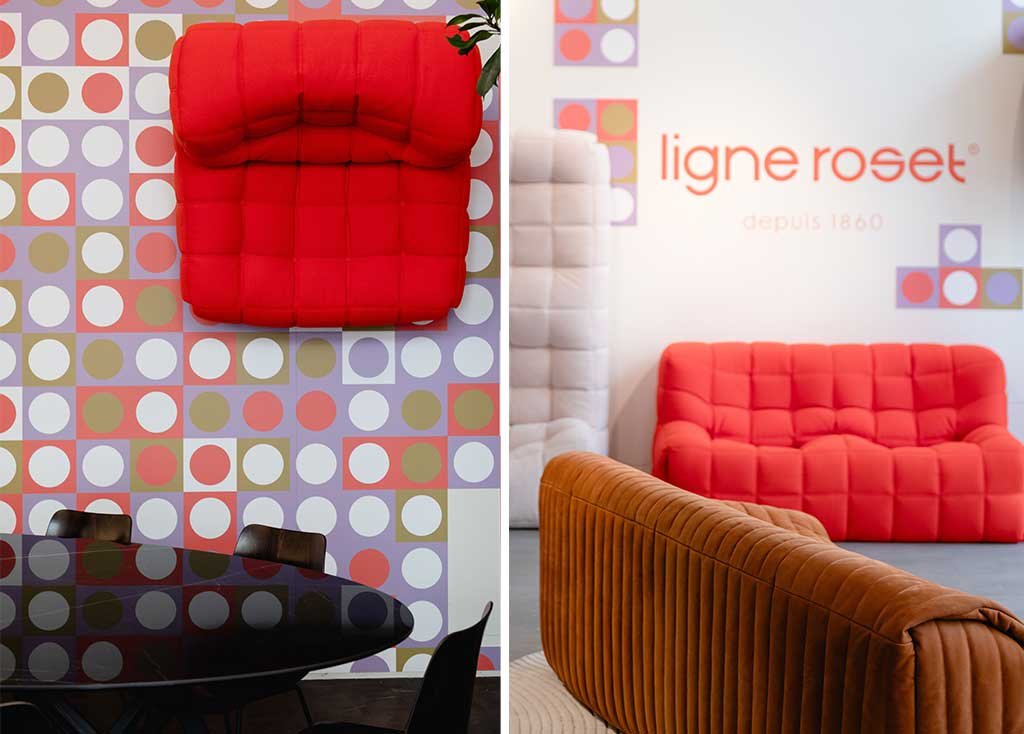
Nelle immagini, l’esposizione Ligne Roset presso lo showroom Mohd in via Turati 3 a Milano, inaugurata durante l’ultima Design Week | photos © Ligne Roset